Sourcing Guide
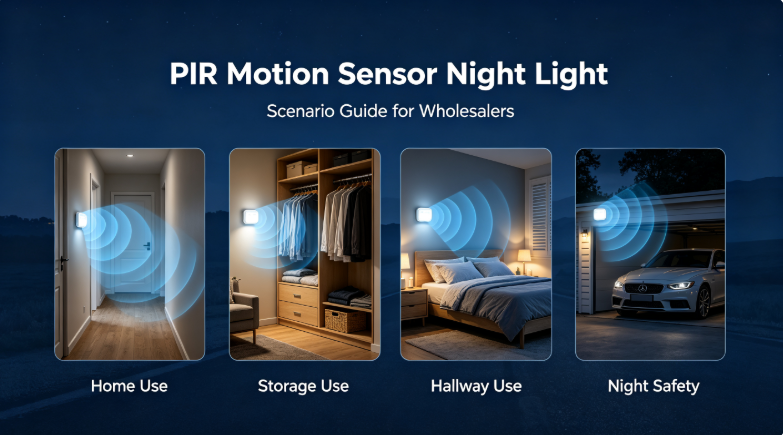
PIR Motion Sensor Night Light: Complete Guide for Wholesalers
A hallway you walk through at night should light itself, not wait for you to find a switch. That is the whole job of a PIR motion sensor night light: it senses body heat, turns on while someone is there, and switches off again about half a minute later. This guide explains how the sensor works, which specifications actually matter, where these lights sell best, and how to source them wholesale. It draws on what we have learned manufacturing them at Guangli Electrical Appliance Factory since 2013.
Quick Answer: A PIR motion sensor night light switches itself on when it detects body-heat movement and off about 30 seconds after you leave, so it uses far less power than an always-on light. Typical specs: 3-5 m detection range, 100-120° angle, a light threshold below 10-20 lux, and standby power under 0.5 W. If you buy for resale, check sensor quality, certifications for your market (ETL, FCC, CE, UKCA), housing material, and the supplier’s MOQ and warranty before you commit to volume.
Key Takeaways
- PIR sensors detect infrared heat from moving people, and a built-in photocell keeps them off in daylight.
- Check detection range (3-5 m), angle (100-120°), delay (30-60 s), and standby power (under 0.5 W) before ordering.
- Match certifications to your market: ETL for North America, CE for Europe, UKCA for the UK, SAA for Australia.
- Standard MOQs start around 500 pieces; logo and packaging customization usually moves it to 1,000-2,000 pieces.
Table of Contents
- Key Takeaways
- What Is a PIR Motion Sensor?
- Why Choose PIR Motion Sensor Night Lights?
- Guangli's PIR Motion Sensor Night Light Products
- Where to Use PIR Motion Sensor Night Lights
- What to Look for When Sourcing PIR Motion Sensor Night Lights
- About Guangli Electrical Appliance Factory
- Frequently Asked Questions (FAQ)
- A Note on Selection and Use
- Sources and References
What Is a PIR Motion Sensor?
PIR stands for passive infrared, and the name tells you how it works. Every warm body - including yours - gives off infrared heat. The sensor reads the heat pattern in its field of view, and when something warm moves across it, that pattern changes. The change is the trigger: the light switches on. The word passive is the important part. The sensor does not send out any signal of its own; it only reads what is already there, which is why these lights draw so little power.
The numbers that matter when you compare models:
• Detection range: typically 3-5 meters
• Detection angle: 100-120 degrees
• Delay time: 30-60 seconds after motion stops
• Light sensitivity: activates only in low-light conditions (below 10-20 lux)
• Power consumption: ultra-low standby power of less than 0.1W
Why Choose PIR Motion Sensor Night Lights?
So why do buyers keep coming back to PIR models? A few reasons come up again and again in real projects:
1. Hands-Free Convenience
You walk in and the light comes on; you leave and it goes off. Nobody has to feel along a wall for a switch at 3 a.m. In a hallway or a child's bedroom, that small difference is the whole reason to buy one.
2. Energy Efficiency
An always-on night light burns power all night, whether anyone needs it or not. A PIR model only lights the moment someone is actually there, so it can cut running energy by up to 80% against an always-on unit. On a single lamp that is a rounding error - across a hotel corridor or a warehouse aisle, it shows up on the bill.
3. Enhanced Safety and Security
Dark stairs and hallways are where most household falls happen. A light that comes on the moment you step into the space gives you something to see by, without hunting for a switch first. The same sudden flicker also makes a would-be intruder think twice, which is a quiet bonus on a porch or a back door.
4. Extended LED Lifespan
Because the light only runs when someone is there, the LED spends most of its life switched off, so it lasts far longer than one left burning all night. The LEDs we fit are rated for more than 30,000 hours.
5. Growing Market Demand
Industry research puts growth in the global motion sensor lighting market at about 8.5% a year through 2028. For a wholesaler or retailer, that is a category still expanding rather than one that has already peaked.
Guangli's PIR Motion Sensor Night Light Products
We build PIR night lights in several shapes and plug types at our plant in Chaozhou. Here are the models buyers order most often, and who each one tends to suit:
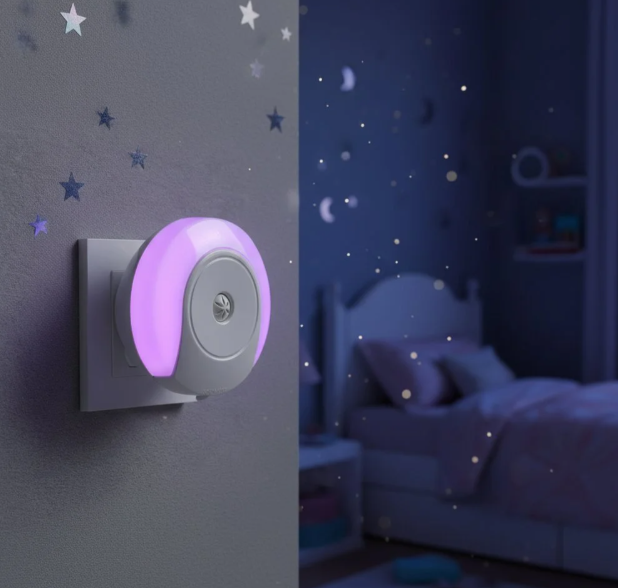
The A78 pairs a PIR sensor with a photocell, so it only lights up when the room is dark and someone is moving.
View the A78 PIR sensor night light
Product Specifications Comparison
• Model A86: Plug-in PIR sensor night light, 0.5W, warm white 2700K, EU/US/UK plug options, CE/FCC/RoHS certified
• Model A78: Round plug-in PIR sensor light, 0.6W, 3000K warm white, photocell + PIR dual sensor, ETL/CE certified
• Model GL-W081: Compact PIR sensor night light, 0.3W, cool white 6000K, US plug, FCC certified
• Model GL-W105: Square PIR motion sensor light, 0.8W, adjustable brightness, EU plug, CE/RoHS certified
• Model HWX-001: Mini PIR sensor night light, 0.4W, warm white, UK plug, UKCA certified
Whichever model you pick, the same core specs run through the range:
• High-sensitivity PIR sensor with 3-5 meter detection range
• 120-degree wide detection angle
• 30-second auto-off delay after motion stops
• Built-in photocell for daylight suppression (only activates in darkness)
• Ultra-low power consumption (less than 1W)
• Long-life LED with 30,000+ hour lifespan
• Flame-retardant ABS housing for safety
• Multiple plug types for global markets
• Comprehensive international certifications
Where to Use PIR Motion Sensor Night Lights
These lights fit almost anywhere people move through in the dark. Buyers usually order them for three broad settings:
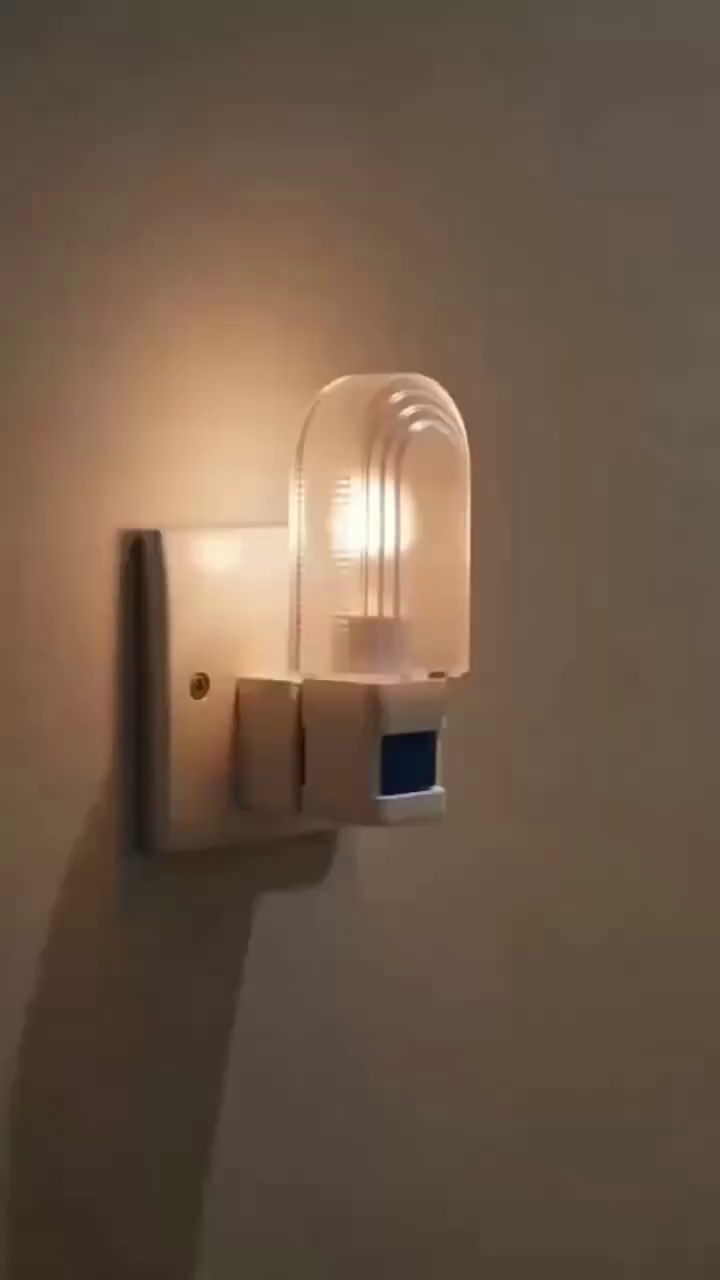
A38 sensor night light in a hallway - the classic corridor and stairway use case.
View the A38 UK plug-in sensor light
Residential Applications
• Hallways and corridors: automatic illumination when walking through
• Bedrooms: soft light for late-night trips to the bathroom
• Bathrooms: no groping for a switch on a night-time trip
• Staircases: enhances safety by illuminating steps
• Closets and pantries: lights up when door opens
• Garages: convenient lighting for entering and exiting
• Basements: provides safety in dimly lit areas
Commercial Applications
• Hotel corridors and guest rooms
• Office hallways and restrooms
• Retail store fitting rooms and storage areas
• Restaurant restrooms and back-of-house areas
• Healthcare facility corridors and patient rooms
• Educational institution hallways
• Warehouse and factory walkways
Outdoor and Semi-Outdoor Applications
• Porches and entryways
• Garage interiors
• Sheds and workshops
• Covered patios
• Stairwells
Related guides and products
- PIR night light collection - all current PIR sensor models in one place
- 2-in-1 photocell + PIR night lights - dual-sensor models that cover both presence and darkness
- motion sensor night light supplier guide - a supplier-side view of PIR plug-in specs
- plug-in night light manufacturer guide - sensor options, plug types, and certifications side by side
What to Look for When Sourcing PIR Motion Sensor Night Lights
If you are buying to resell, most of your risk sits with the supplier rather than the product. These are the things worth checking before you place a first order:
1. Sensor Quality and Reliability
The sensor decides almost everything about how the light feels in daily use. Ask where it comes from and how the supplier tests for false triggers - a light that flicks on for a passing cat earns bad reviews fast. We test ours for steady pickup and few false activations before they ship.
2. Certifications and Compliance
Ensure the products hold relevant certifications for your target market: CE for Europe, FCC for the US, UKCA for the UK, ETL for North America, RoHS for environmental compliance, and SAA for Australia. Our models carry the certifications for the markets we ship to most.
3. Build Quality and Materials
Look at the housing and the pins. Flame-retardant ABS is the safer choice for a light that stays plugged in overnight, and copper or brass pins hold up better than plated steel through years of insert-and-remove.
4. LED Quality and Color Temperature
Colour temperature is where one market differs from the next. Warmer tones suit bedrooms and living rooms; cooler white reads as brighter and more functional. We build 2700K, 3000K, and 6000K so you can match what your own market already buys.
5. Power Consumption and Energy Efficiency
Standby draw is the spec buyers forget to ask about. A PIR light that pulls current while it is only watching for movement is not really saving anything. Ours run at 0.3-0.8W while on, and under 0.1W while idle.
6. MOQ and Pricing
MOQ is where a lot of first orders stall. We start standard models at 500 pieces, and the unit price steps down as volume rises.
7. Customization Options
If the light will go out under your own name, find out how far the supplier will customize: logo printing, packaging, colour, and spec changes. We handle all four, from a mark on the housing to packaging built around your brand.
8. Quality Control and Warranty
Ask what happens when something goes wrong. We run ISO9001 quality management with three-stage in-line inspection, aging tests, and voltage-withstanding checks, and we back the product with a one-year warranty. Our field defect rate runs under 0.2%.
About Guangli Electrical Appliance Factory
Guangli Electrical Appliance Factory is based in Chaozhou, Guangdong - a city better known for ceramics, and increasingly for small electrical goods. We have been making LED night lights and safety lamp holders since 2013, and night lights are essentially all we do.
The plant runs to over 3,000 square metres with five production lines and our own mould shop. Close to 100 of the moulds are exclusive to us, which is what lets us offer this many shapes without long tooling lead times. Alongside PIR models we build plug-in, light-controlled, ceramic, cartoon, and aromatherapy night lights, plus a full range of safety lamp holders.
Quality runs under our ISO9001 system (certificate ISC-Q-2025-7396-R): three full-process inspections, aging tests, and voltage-withstanding insulation checks. On the paperwork side, our products carry CE, RoHS, BS, SAA, ETL, cETL, UKCA, FCC, and PSE - which between them cover most of the markets our buyers sell into.
We ship to more than 50 countries and hold long-standing supply relationships with major retail brands including Walmart, RT-Mart, and The Home Depot. Whether you need straight OEM (we build to your design), ODM (you choose from ours), or OBM, the same team runs the order end to end.
Frequently Asked Questions (FAQ)
Q: What is the difference between PIR motion sensor and photocell (dusk-to-dawn) sensor?
A: They respond to different things. A PIR sensor watches for movement, so the light comes on only when someone is actually there and goes off about 30 seconds after they leave. A photocell (dusk-to-dawn) sensor watches the light level instead: on at dusk, off at dawn, on all night in between. For the lowest running cost, choose PIR. For steady overnight light, choose photocell.
Q: Can PIR motion sensor night lights be used outdoors?
A: Most PIR night lights are built for indoors. For covered spots like a porch, a garage, or a shed, we offer models with weather-resistant housings. For fully exposed outdoor use, choose from our outdoor-rated sensor lights - tell us where it is going and we will point you to the right model.
Q: What is the minimum order quantity (MOQ) for PIR motion sensor night lights?
A: Standard models start at 500 pieces per model. Add logo printing or custom packaging and the MOQ usually moves to 1,000-2,000 pieces, depending on how much changes.
Q: How long does it take to produce and deliver PIR motion sensor night lights?
A: In-stock standard items usually ship within 3-5 business days. Made-to-order runs typically take 15-25 days, depending on quantity and customization. Five production lines keep that schedule steady through peak season.
Q: Do you offer OEM/ODM customization for PIR motion sensor night lights?
A: Yes. We can print your logo on the housing (silk-screen or laser), build packaging to your spec (blister packs, colour boxes), adjust details such as colour temperature and detection range, and develop new models from your drawings. Industrial designers and electromechanical engineers are on staff for that last part.
A Note on Selection and Use
Detection range, angle, delay, and power figures in this guide are typical for PIR plug-in night lights and vary by model. Confirm the exact values, certification scope, and warranty terms against the datasheet and test report for the specific model you plan to order.
Sources and References
- UL Solutions - safety certification referenced across this guide
- Intertek - ETL Listed testing for the certified models above
Last updated: October 10, 2026.
Ready to Source Quality LED Night Lights?
Contact Guangli today for a free quote and sample!
0users like this.