Sourcing Guide
OEM Night Light Factory: Custom LED Lights and Private Label
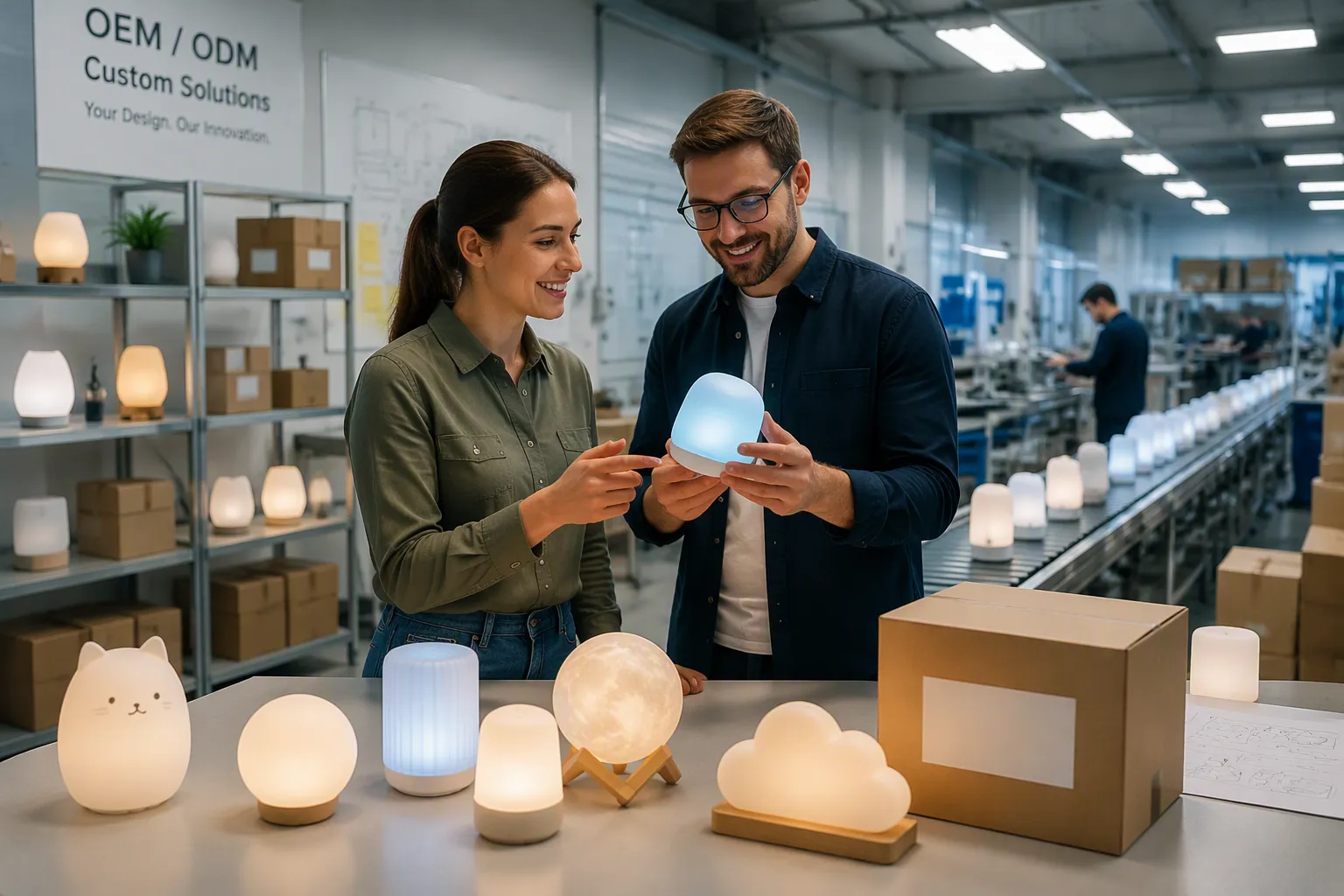
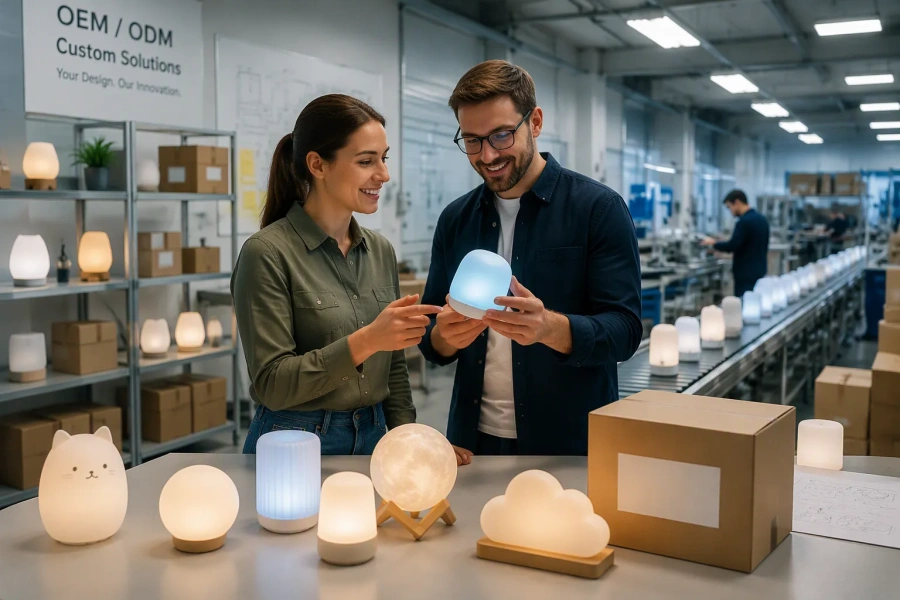
Quick Answer: An OEM night light factory builds the product to your specification and puts your brand on it; what changes between suppliers is how much of the product they control. The four things that decide whether an OEM project runs smoothly are the factory's own tooling and injection capability, its electronics and assembly line, its certification capability under your brand, and its packaging and private-label workflow. Ask who owns the mould, whose name sits on the certificate file, and how packaging artwork is approved before printing. Those three answers tell you more than a catalogue.
Table of Contents
- Key Takeaways
- Why Custom LED Night Lights Sell
- OEM vs. ODM: Which Model Fits You
- Product Details to Confirm Before Production
- Safety and Compliance Requirements
- From Concept to Mass Production
- How to Select the Right OEM Night Light Factory
- Private Label and Packaging Customization
- Practical Tips and Case Examples
- Sources and References
You have a great idea for a branded LED night light. You do not need your own factory to make it real. An oem night light factory handles the hard parts for you. They manage design, tooling, electronics, safety testing, and custom packaging. You focus on your brand and your customers. Talk to your manufacturer early. Good communication saves you time, money, and painful redesigns later.
Key Takeaways
- Custom LED night lights boost your profits and brand recognition.
- Choose OEM for full design control or ODM for speed and low cost.
- Confirm product details like shape, LED color, and battery before production.
- Meet safety standards and certifications for your target market.
- Select a factory with valid certifications, quality samples, and clear communication.
Why Custom LED Night Lights Sell
Higher Margins Than Generic Products
Generic night lights compete on price alone. That race to the bottom leaves you with thin profits. A custom LED night light changes the game. You control the design, the features, and the brand story. Customers pay more for a product that feels made for them. A parent shopping for a nursery wants safety and style. A gift buyer wants something special. Your branded light meets that need. You set a premium price. Your margin grows. You also avoid competing with a dozen identical products on a marketplace shelf.
Stronger Brand Recognition
Every time a customer plugs in your night light, they see your logo. They touch your packaging. They read your manual. That repeated exposure builds memory. A generic product disappears into the background. Your branded light stays visible in a bedroom or hallway for years. Word of mouth follows. One happy parent tells another. Your brand becomes the name they trust for children's lighting. That trust turns into repeat purchases and referrals.
Better Fit for Target Markets
Different buyers want different things. You can shape your product around a specific audience. Consider these key segments:
- Parents and caregivers want safe, comforting nursery lighting with dusk-to-dawn sensors and soft color temperatures.
- Millennial and Gen Z parents seek ambient, thematic, and interactive lamps that support sleep hygiene and cognitive development.
- Premium and nesting-oriented parents will pay more for design-led, safety-certified, feature-rich kids' lamps.
- Eco-conscious consumers favor sustainable materials like FSC-certified wood, bamboo, or recycled ABS.
- Commercial buyers such as daycare centers, pediatric clinics, and hotels need durable, low-level illumination for safety and wayfinding.
A generic product cannot serve all these groups well. A custom LED night light can. You pick the shape, the light color, the sensors, and the materials. Your product fits your market like a key in a lock.
Room to Innovate and Differentiate
Generic night lights all look the same. They glow the same soft white. They sit in the same plain plastic shell. Your custom LED night light does not have to follow that pattern. You get real room to try new ideas.
Think about what makes your product stand out. You could add a fading sunset mode that helps a toddler drift off to sleep. You could build a touch sensor that changes colors with a single tap. You could shape the housing like a cloud, a rocket, or a friendly animal. You could even add a small speaker for lullabies or white noise.
Here are a few directions worth exploring:
- Interactive features like motion sensors, voice control, or app pairing.
- Unique materials such as silicone, bamboo, or soft-touch recycled plastic.
- Themed designs built around holidays, popular characters, or room decor trends.
- Multi-function use that combines a night light with a clock, a sound machine, or a wireless charger.
Each choice gives customers a new reason to pick your brand. A plain light solves one problem. A clever light solves several. That difference shows up in reviews, in photos, and in repeat sales.
You also stay ahead of the market. Trends shift fast in home and kids' products. A factory partner with flexible tooling lets you test fresh ideas without a huge investment. You can launch a new color, a new shape, or a new feature every season. Competitors stuck with generic stock cannot move that fast.
Innovation does not mean complexity for its own sake. It means finding one or two details that matter to your buyers. Nail those details. Your product becomes the one people remember.
The design and mould path is described in custom night light manufacturing.
OEM vs. ODM: Which Model Fits You
What OEM Manufacturing Means
OEM stands for Original Equipment Manufacturer. In this model, you bring the design. You decide the shape, the LED color, the sensors, and the materials. The factory builds your product to your exact specs. You own the design rights, so no one else can sell your custom light. This path gives you full control. It also asks more of you upfront. Custom tooling can run from $30,000 to $100,000 or more. Development often takes 8 to 14 months. Choose OEM when you want a signature product that stands apart.
What ODM Manufacturing Means
ODM stands for Original Design Manufacturer. Here, the factory already designed the product. You pick from their catalog and add your brand. You can tweak colors, packaging, or small features. The factory handles engineering and safety certifications. Your costs stay low, and you skip tooling fees. Time to market drops to 30 to 45 days. The trade-off? The factory keeps the design rights. Another brand could sell the same light with a different logo. Pick ODM when speed and low risk matter most.
Key Differences in Cost, Speed, and Control
The table below sums up the main trade-offs.
| Factor | OEM | ODM |
|---|---|---|
| Product Design | Your custom specs | Factory's standard design |
| Customization | High | Moderate |
| IP Ownership | Yours | Factory's |
| Upfront Cost | High | Low |
| Lead Time | 3–6 months | 30–45 days |
| Exclusivity | Full | Low |
Your choice depends on your goals. Startups testing a new market often begin with ODM. A successful test lets you move to OEM later. Brands with a strong identity usually go straight to OEM. Some take a hybrid path. They use ODM for filler products and reserve OEM for flagship pieces. Talk to your oem night light factory about both options before you commit.
How to Choose the Right Model
Your choice comes down to one question: how much control do you need? OEM fits brands with a clear product idea. You supply sketches, 3D files, industrial design drawings, and packaging concepts. The factory then handles engineering review, mold making, electronics, sampling, and testing. This path gives you a product no one else can sell.
ODM fits brands that want speed. You pick an existing product concept and customize brand colors, logos, surface decoration, or packaging. The base structure is already tested, so your early development risk drops. You still need to confirm product positioning, target age group, sales market, quality level, and compliance requirements. ODM does not mean skipping details.
Before you commit, gather your materials. A good oem night light factory will ask for these items:
- Product drawings or 3D files
- Target size and material requirements
- Lighting modes and battery capacity
- Charging method and switch type
- Timer function needs
- Logo and brand color references
- Packaging type and target quantity
- Target market and testing requirements
A strong manufacturer will clearly explain which parts you can customize, which are fixed, and which changes require new tooling. That transparency tells you a lot about how they work.
Many brands take a hybrid path. Launch an ODM product first to test demand. Then invest in OEM for your hero products. This approach balances speed with differentiation. Some factories even offer partial ODM customization, like changing the light color, housing material, or sensor sensitivity. That middle ground works well for startups that are not ready for full tooling costs.
Formats suited to private label are listed across the night light range.
Product Details to Confirm Before Production
You have your manufacturing model picked out. Now comes the part where small decisions turn into big consequences. Every detail you lock in here shapes your tooling costs, your safety testing, and your final retail price. Get these specs right before you pay for molds. Changes after tooling starts can cost thousands of dollars and weeks of delay.
Shape, Size, and Material
Your night light's shape drives everything else. It decides how the light spreads, where the battery sits, and how the product feels in a child's hand. Start with your target user. A toddler wants a soft, rounded form with no sharp edges. A tween might prefer a sleek geometric design that fits a desk or shelf.
Size matters more than you think. A light that is too small can overheat. A light that is too large feels bulky on a nursery wall. Most night lights fall between 3 and 6 inches in height. Confirm the exact dimensions with your factory before you approve any 3D drawings.
Material choice affects safety, cost, and brand perception. Here are the common options:
- ABS plastic is durable, cheap, and easy to mold. It works well for high-volume runs.
- Silicone feels soft and safe for babies. It also resists heat and drool.
- Bamboo or FSC-certified wood appeals to eco-conscious buyers. These materials cost more and need extra treatment for moisture.
- Recycled ABS gives you a sustainability story without losing durability.
Ask your factory about wall thickness, drop-test ratings, and surface finish. A glossy finish shows fingerprints. A matte finish hides scratches. These small choices shape how customers judge your product in the first five seconds.
LED Color, Brightness, and Modes
Light color and brightness are not just technical specs. They affect how a child sleeps, how a parent feels, and how your product performs in reviews. Blue light disrupts melatonin production. Warm amber light supports natural sleep cycles. That science should guide your choices.
The right settings depend on your target age group. Here is a quick reference:
| Age group | Recommended color temperature | Recommended brightness |
|---|---|---|
| Baby | Amber/orange glow around 1800–2200K | Very dim, under 5 lux |
| Four-year-old | Amber tone, around 1800–2200K | Under 10 lux |
| Ten-year-old | Amber tone, around 1800–2200K | Optional, 5–10 lux |
Notice the pattern. Amber tones around 1800–2200K work across all ages. Brightness stays low. A night light should guide a child to the bathroom, not light up the whole room.
Now think about modes. Do you want a single on/off switch? Or do you want dimming, color cycling, or a fade-to-sleep timer? Each mode adds cost and complexity. A simple touch dimmer is cheap and reliable. A full RGB color wheel with app control costs more and needs firmware testing. Pick the modes your customers will actually use. Extra features that nobody touches just raise your price and your failure rate.
Battery Type and Charging Options
You have three main power paths: plug-in, battery, and rechargeable. Each one fits a different use case.
Plug-in night lights never run out of power. They work well for hallways and bathrooms. But they need an outlet nearby. They also limit where a child can carry the light.
Disposable battery models run on AA or AAA cells. They are cheap to make and simple to use. Parents replace the batteries when needed. The downside? Ongoing battery costs and environmental waste.
Rechargeable models use a built-in lithium-ion or lithium-polymer cell. They offer the most flexibility. A child can carry the light to bed, to the bathroom, or on a trip. Charging happens through USB-C, micro-USB, or a docking base. USB-C is the modern standard. It charges faster and works with more cables.
Confirm these details with your factory:
- Battery capacity in mAh and expected runtime per charge
- Charging time from empty to full
- Charging port type and location
- Overcharge and short-circuit protection features
- Battery certification requirements for your target market
Safety comes first with any battery product. Lithium cells need protection circuits to prevent overheating. They also need UN 38.3 testing for shipping. Ask your factory for the battery test reports before you approve the design. A cheap cell can save you a few cents per unit. A failed safety test can cost you your entire launch.
Controls, Sensors, and Smart Features
A night light with the right controls feels effortless. A night light with the wrong ones feels annoying. Think about how your customer will use the product at 2 a.m. A sleepy parent does not want to fumble for a tiny switch. A simple touch sensor or a large button solves that problem. A dusk-to-dawn sensor turns the light on when the room gets dark. That feature sells well to parents who want hands-free operation.
Smart features add value, but each one raises your cost and your testing burden. Motion sensors work great for hallway lights. Timers help children learn to sleep through the night. App control and voice assistant pairing appeal to tech-savvy buyers. Ask yourself one question for every feature: will my customer actually use this? If the answer is no, cut it. Fewer features mean fewer failure points and a lower return rate.
Packaging Format and Retail Requirements
Your packaging is not an afterthought. It is the first thing a customer sees on a shelf or in a product photo. Pick a format that matches your sales channel:
- Bulk packaging keeps costs low for large orders.
- Individual packaging suits e-commerce and single-unit retail.
- Gift packaging adds presentation value for premium buyers.
- Shelf-ready packaging lets stores place your product directly on display.
Each retail channel has its own rules. Here is what you need to know:
| Retail channel | Packaging and label requirements | Barcode requirements |
|---|---|---|
| Amazon FBA | Units arrive fully prepped; poly bags at least 1.5 mil with a suffocation warning if the opening is 5 inches or larger; packaging must survive a 3-foot drop test | Every unit needs a scannable FNSKU or UPC; cover other barcodes to avoid commingling |
| Walmart physical stores | Retail-Ready Packaging follows the "5 Easies": easy to identify, open, stock, shop, and dispose | A unique GS1 UPC is required, plus scannable 14-digit case barcodes |
| Walmart online / WFS | Items must arrive ready to ship, similar to Amazon FBA | Correct scannable barcodes on every unit |
Always approve a packed-product sample and a carton plan before mass production. That step catches barcode placement errors, label mistakes, and fit problems early.
Where the SKU is decorative, the decorative night light range covers the shapes available.
Safety and Compliance Requirements
Electrical Safety Standards by Market
Every market has its own electrical safety rules. You cannot sell a night light in the United States with European certifications alone. Each region tests LED components and complete fixtures against specific standards. Here is what you need to know:
| Region | Applicable LED Safety Standard(s) | Scope |
|---|---|---|
| United States | UL 8750 (LED components/drivers); UL 1598 (complete luminaires) | LED modules, drivers, and LED equipment; complete luminaires |
| European Union | EN 62031; EN 61347-2-13 | CE-marked LED components (modules and control gear) |
| Australia / New Zealand | AS/NZS 62031; AS/NZS 61347 | LED safety compliance |
Ask your factory which standards they already meet. A good partner will have test reports ready. If they hesitate, look elsewhere.
Battery and Charging Regulations
Lithium batteries face strict shipping and safety rules. UN 38.3 testing is mandatory for air transport. Your factory must provide this report before any shipment leaves the door. Overcharge protection and short-circuit safeguards are non-negotiable. Cheap cells without protection circuits can overheat or catch fire. That risk destroys your brand overnight. Confirm the charging port type, voltage, and current limits with your manufacturer. USB-C is the modern standard, but some markets still accept micro-USB. Match your choice to your target buyer's devices.
Material and Child-Safety Rules
Children's products face extra scrutiny. You need to prove your night light is safe for kids at every stage. Keep these requirements in mind:
- Check age appropriateness: for children under 3, avoid small detachable parts and confirm ASTM F963 toy safety compliance.
- Assess material safety: use flame-resistant, hypoallergenic, and non-toxic materials, and look for labels such as CPSIA, CE, or EN71.
- For electric or LED children's products, follow U.S. FCC and CPSIA requirements and EU CE marking with EN 62115 electrical safety; use secure battery compartments and low-heat LEDs.
ASTM F963 is the mandatory U.S. toy safety standard. It covers material quality, physical hazards, flammability, and toxicology. EN 71 is the EU Toy Safety Directive standard. It addresses mechanical properties, flammability, and chemical heavy-metal migration limits. CPSIA adds U.S. rules for lead and phthalates, third-party testing, and a Children's Product Certificate. Electric children's products must also meet EN 62115 and FCC/CPSIA rules. Lock these certifications in before you start tooling. A failed test after production wastes your money and your time.
Required Certifications and Labels
Certifications prove your night light meets safety rules. They also open retail doors. Each market wants its own marks. Here is a quick look at what major regions require.
| Market/Region | Marks/labels |
|---|---|
| US | UL, ETL, FCC |
| Canada | CSA (voluntary) |
| EU/EEA | CE, RoHS, Ecodesign, ErP |
| Germany/Europe | GS, VDE |
| UK | UKCA, BS |
| Australia | SAA |
| Japan | PSE, JIS |
| China | CCC |
| Eurasian Union | EAC |
| Saudi Arabia | SABER |
| South Africa | SABS (voluntary) |
| Mexico | NOM |
| Brazil | INMETRO |
| International | CB scheme |
A plug-in LED night light often carries CE and RoHS labels for Europe. In North America, ETL and UL are the same safety standard with different marks. You can use either one. For the UK, you need a UK plug format and UKCA or BS marks.
Certification is model- and market-specific. A US 120 V unit is not automatically covered for a 230 V European order.
Changes to the LED board, driver, or housing material can void your listing. That means you must retest after any major design change. Ask your factory for current test reports before you commit. A good partner keeps these documents ready. If they stall or send expired papers, walk away. Your brand depends on clean, valid certifications.
From Concept to Mass Production
You have your specs and your compliance plan. Now the real work begins. This stage turns your idea into a physical product. It follows a clear path. Each step builds on the one before it. Skip a step, and you pay for it later. Follow the path, and you get a night light that matches your vision and your budget.
Step 1: Brief and Feasibility Review
Everything starts with a brief. This document tells your factory what you want to build. A vague brief wastes everyone's time. A clear brief gets you an accurate quote and a realistic timeline. Think of it as the blueprint for your whole project.
A strong brief covers several key fields. Include these items in your first message:
- Project objective and your role as the buyer
- The closest existing model to your idea
- Fixed requirements versus nice-to-have preferences
- Variant and personalization data
- Target market, destination, and delivery terms
- Requested proof or sample stage
- Commercial fields you need for comparison
Before you compare optional changes, confirm the basics. Lock down the use context, the order quantity, the destination, the required arrival date, and your fixed product requirements. These answers shape everything else.
Your factory will also want more detail for an accurate quotation. Send your artwork or product concept, your estimated order quantity, the acrylic dimensions, your preferred lighting functions, your packaging needs, your branding requirements, and your target market. The more complete your specs, the tighter the quote. A good oem night light factory will tell you which parts need more clarity. They will also flag any feature that drives up cost or lead time.
The feasibility review comes next. Your factory checks whether your design can be made at your target price. They look at tooling complexity, material availability, and testing needs. They may suggest small changes that save money without hurting the product. Listen to these suggestions. A factory that pushes back on a bad idea is worth more than one that says yes to everything.
Step 2: Design and 3D Mockups
Once the brief is approved, the design phase begins. Your factory turns your concept into detailed drawings and 3D mockups. These files show the exact shape, size, and structure of your night light. You will see how the housing fits together, where the battery sits, and how the light spreads.
Pay close attention to the 3D renderings. They reveal problems that sketches hide. Check the wall thickness. Thin walls crack under stress. Check the seam lines. Visible gaps look cheap and collect dust. Check the button placement. A switch on the bottom feels awkward for a child. A switch on the top feels natural.
This stage also covers the internal layout. Your factory maps out the LED board, the driver, the battery, and the wiring. A crowded interior traps heat. A loose interior rattles. Both problems hurt your reviews. Ask for cross-section views so you can see how everything fits.
You will go through a few rounds of revisions here. That is normal. Each round brings you closer to a final design. Approve the 3D files in writing before anyone cuts metal. Changes after tooling starts cost thousands of dollars. Changes at the mockup stage cost almost nothing.
Step 3: Prototyping and Sampling
The design is locked. Now your factory builds a real sample. This step proves the design works in the physical world. A prototype reveals what drawings cannot. You can hold it, plug it in, and test every feature.
Your first sample may have flaws. That is the point. You want to find problems now, not after you order 10,000 units. Test the light output. Test the battery life. Test the touch sensor. Drop it on a hard floor. Hand it to a child and watch how they use it. Real-world testing catches issues that lab tests miss.
Here is what to check on every sample:
- Engraving clarity and acrylic dimensions
- LED performance and lighting modes
- Assembly quality and component fit
- Appearance and surface finish
- Packaging and branding details
Approve a sample before mass production. This step protects you. The approved sample becomes the reference for the bulk order. Your factory compares every unit against it. That comparison keeps quality consistent across the whole run.
You should also establish written specifications at this stage. Cover the acrylic plate, the LED base, the control method, the power supply, the packaging, and the labeling. Define your production standards and inspection procedures. These documents remove guesswork. They also give you leverage if the bulk order drifts from the approved sample.
Expect two or three sample rounds for a custom design. Each round takes one to two weeks. Rushing this step saves a little time upfront. It costs far more when defects show up in mass production. Take the time. Get the sample right.
Step 4: Tooling and Mold Making
Your approved sample now becomes a mold. This step is where your design turns into steel. It is also where you spend the most money in one shot. A single injection mold can cost anywhere from $3,000 to $30,000. That price depends on the part size, the number of cavities, and the surface finish you want. Pay close attention here. A mistake at this stage is expensive to fix.
Your factory cuts the mold from hardened steel or aluminum. Steel lasts longer and handles high-volume runs. Aluminum costs less and works well for small test batches. Ask your factory which material they plan to use. Then ask how many shots the mold can handle before it wears out. A good mold should survive 100,000 cycles or more.
Tooling takes time. Expect three to six weeks for a simple housing. Complex shapes with moving parts take longer. Your factory will run a test shot once the mold is ready. This shot shows whether the plastic fills the mold correctly. Look for short shots, sink marks, and warping. Each flaw points to a problem in the mold design. Your factory fixes these issues before they cut the final production mold.
You should also confirm who owns the mold. In an OEM deal, you pay for the tooling. That means you should own it. Get this in writing. Some factories keep the mold and charge you again if you switch suppliers. A clear ownership clause protects you. It also gives you leverage if quality slips later.
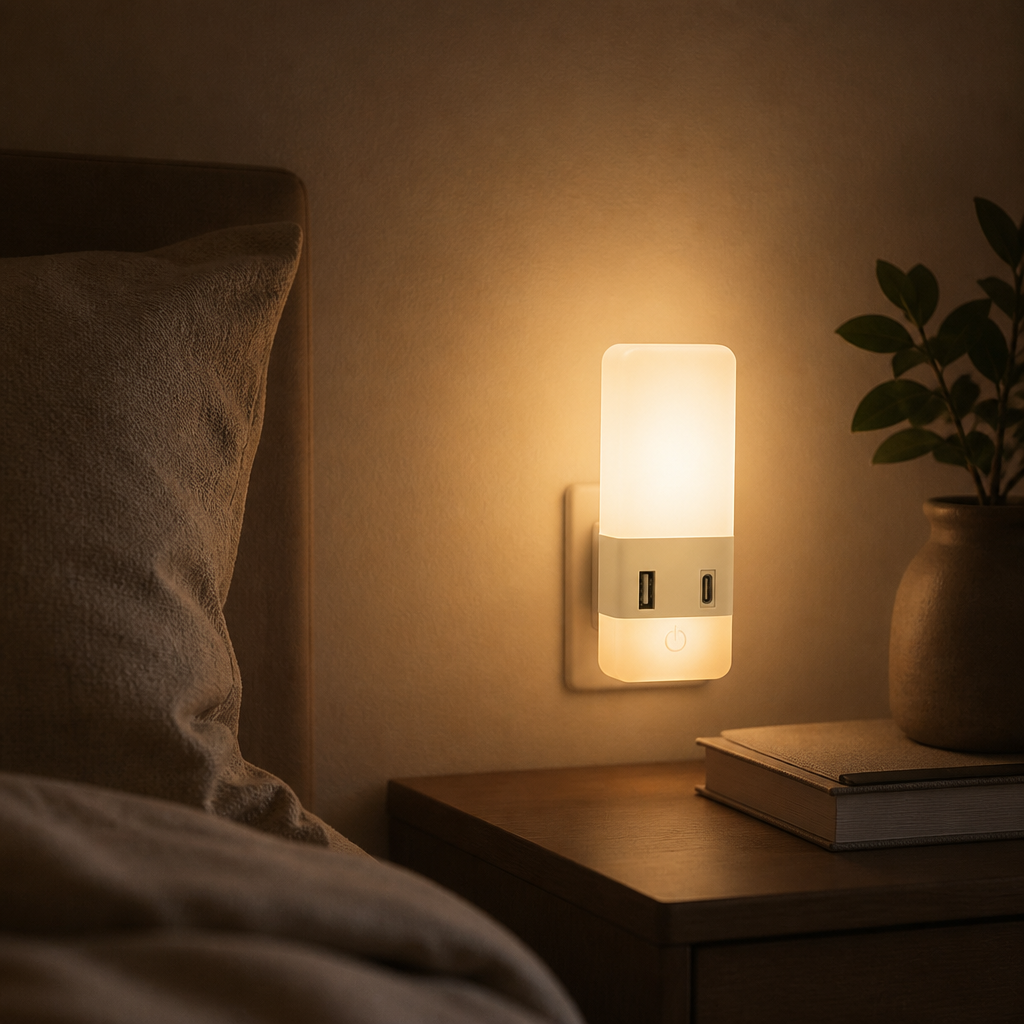
A90D Dusk-to-Dawn Sensor Night Light with USB Charging
- Dusk-to-dawn sensor with automatic switching
- USB-A and Type-C charging ports
- Plug-in format for bedroom and hallway use
- Suited to OEM and private-label programmes
Step 5: Pilot Run and Quality Checks
The mold works. Now your factory runs a small batch to prove the whole line holds up. This pilot run typically covers 50 to 100 units. It is your last chance to catch problems before you commit to thousands of pieces. Treat this step with care. A pilot run costs little. A failed mass order costs everything.
Your factory checks many things during this run. The table below shows the main checkpoints and what each one proves.
| QC Stage | What to Check | Acceptance Standard |
|---|---|---|
| Artwork approval | Film file, Pantone/RGB reference, projection size | Buyer approval before film production |
| Incoming LED inspection | Color temperature bin, luminous flux, batch reference | Within specified bin range |
| Film production check | Color accuracy vs. reference, sharpness, defects | Match golden sample film |
| Prototype sample | Projection clarity, brightness, motion, controls | Buyer-approved golden sample |
| LED calibration | Color consistency, brightness range, heat rise | Within ±200K color temperature tolerance |
| Optical alignment | Focus, distortion, projection angle, coverage | Match golden sample projection |
| Battery test | Runtime at standard brightness, charging time, Type-C stability | At or above specified runtime; full charge within specified time |
| Function test | Remote, APP, Bluetooth pairing, timer, speaker, dimming | 100% pass on all functions |
| Safety check | Electrical safety, battery protection circuit, optical safety | Compliant with applicable standard |
| Packaging test | Drop test, accessory completeness, FBA label, manual | Pass drop test; all accessories present |
| Final AQL inspection | Statistical sampling against golden sample | AQL 2.5 or buyer-specified level |
Watch for the defects that show up most often in this stage. Film color drift happens when printed projection films shift in hue, saturation, or contrast between the prototype and the bulk order. That shift occurs when no controlled color reference is used. Projection sharpness can degrade too. Undocumented optical alignment procedures cause focus shifts, which produce blurry edges, distorted patterns, or uneven brightness. LED color temperature varies from batch to batch without proper binning and calibration. Battery runtime may fall short if the cells are undersized, the power management is weak, or the charge was incomplete before testing. Function inconsistency is another common issue. Remote controls, Bluetooth pairing, app connectivity, and timer functions can behave differently if you do not test them under realistic conditions across a representative sample.
Step 5 — Pilot run. Produce a small batch (typically 50–100 units) to verify assembly stability, QC consistency, and packaging completeness before committing to full bulk production.
The golden sample principle: before bulk production begins, buyers should request a golden sample that locks all variables—approved film, confirmed LED color and brightness, verified projection distance and focus, confirmed battery runtime, tested control functions, and final packaging. This golden sample becomes the physical reference standard against which bulk production is inspected.
That golden sample is your anchor. Keep it sealed and labeled. Every unit in the bulk order gets compared against it. If a unit drifts from the golden sample, your factory catches it before it ships. This single step prevents most quality disputes. It also gives you proof if a batch arrives wrong.
Step 6: Mass Production and Shipping
The pilot run passed. Your golden sample is locked. Now the line runs at full speed. This is the moment your product becomes real at scale. It is also the moment you need to stay sharp. Mass production rewards planning and punishes guesswork.
Lead times depend on your manufacturing model. The table below gives you a realistic picture.
| Production mode | Lead time | Shipping / trade terms |
|---|---|---|
| ODM with branded customization on existing platforms | 8–12 weeks from contract to first shipment | Worldwide shipping via logistics partners; customs documentation and ocean/air freight packaging included; CE-marked equipment ships freely in EU/EFTA; US-made units ship in North America without import duty |
| OEM production to engineering drawings | 12–20 weeks from contract to first shipment; 25–50% premium for expedited slots | Worldwide shipping via logistics partners; customs documentation and ocean/air freight packaging included; CE-marked equipment ships freely in EU/EFTA; US-made units ship in North America without import duty |
Smaller custom runs move faster. Stock items ship in 3 to 7 days, or 8 to 15 days when inventory runs low. Custom light projectors take 25 to 35 days after your deposit clears and your customization details are confirmed. Most factories ship from Guangzhou. You can choose self-pickup, express, air freight, or sea freight. Common trade terms include EXW and FOB.
During production, your factory runs inspections at set intervals. They check the first articles off the line. They spot-check units throughout the run. They pull a final sample before packing. Ask for photos and videos at each checkpoint. A good oem night light factory sends these updates without you asking. If your factory goes quiet for weeks, that silence is a warning sign.
Packing deserves its own attention. Confirm the carton count, the label placement, and the drop-test results. Check that every accessory sits in the box. A missing cable or manual creates returns and angry reviews. Ask for a pre-shipment inspection report before the goods leave the factory. This report confirms the quantity, the quality, and the packaging. It also protects you if the shipment arrives damaged.
Shipping itself has two main paths. Sea freight costs less and takes longer. Air freight costs more and moves fast. Pick the path that matches your launch date and your budget. Book your freight forwarder early. Space fills up during peak season. A late booking can delay your launch by weeks.
Track your shipment from the factory door to your warehouse. Ask for the bill of lading and the tracking numbers. Confirm the customs paperwork matches your product and your destination. A paperwork error can hold your goods at port for days. That delay costs money and frustrates your customers.
Once the goods arrive, inspect them against the golden sample. Check a random sample from several cartons. Confirm the function, the finish, and the packaging. If something looks wrong, document it with photos and contact your factory right away. Most factories fix genuine defects. Fast communication keeps the relationship strong and your next order smooth.
Sensor models for OEM lines are grouped in the PIR night light range.
How to Select the Right OEM Night Light Factory
You have your product idea, your specs, and your compliance list. Now you need the right partner to build it. This choice shapes everything that follows. A strong factory protects your brand, your budget, and your launch date. A weak one costs you money, time, and customer trust. So how do you tell them apart? You look past the sales pitch. You check the paperwork, you test the samples, and you watch how they communicate. Let's walk through each step.
Check Certifications and Audit Reports
Certifications are your first filter. Any factory can claim they meet safety standards. Fewer can prove it with current, valid documents. Ask for the actual test reports, not just a logo on a brochure. You want to see reports tied to the exact model and configuration you plan to order. A certificate for a different product tells you nothing.
Start with the core documents. For a plug-in LED night light, look for UL 8750 or UL 1598 reports for the US market. For Europe, ask for EN 62031 and EN 61347-2-13 test results. If your product uses a lithium battery, request the UN 38.3 transport report. For children's products, add ASTM F963, CPSIA, and EN 71 documentation. A reliable partner keeps these files organized and ready to share.
Compliance documentation matters because you need more than claims. Depending on your application, useful documents may include safety certifications, performance testing, environmental compliance, and materials declarations such as RoHS, electrical safety, and third-party validation tied to light emission and output. Ask your factory to map each document to your target market and your exact product configuration. If they cannot explain which report covers which market, that gap tells you something.
Audit reports add another layer of proof. Many large buyers require a social compliance audit, a quality management audit, or both. Look for ISO 9001 certification for quality systems. Check for BSCI, Sedex, or similar social audits if you care about labor practices. These reports show that an independent party reviewed the factory's processes. They do not guarantee perfect quality. They do show that the factory opens its doors to outside review.
Now think about how to weigh all this evidence. You can score each factory against a clear set of categories. The table below shows one useful framework.
| Evaluation Category | Weight | What Earns the Score |
|---|---|---|
| Product and engineering fit | 20 | Proposed model, drawings, configuration and deviations are controlled |
| Model-level compliance evidence | 15 | Applicable evidence maps to the legal entity, market and exact configuration |
| Quality and traceability controls | 15 | Inspection, measurement, nonconformance and traceability records are usable |
| Representative sample | 15 | Identified sample passes a written, risk-based review |
| Change control | 10 | Notification, approval and retest decisions are defined |
| Production and inspection visibility | 10 | Process ownership, inspection points and lot acceptance are clear |
| Communication | 5 | Answers, assumptions, revisions and dates are recorded consistently |
| Commercial and logistics fit | 10 | Scope, inclusions, packaging, terms and pilot plan are aligned |
This scoring model keeps you objective. It stops a smooth sales pitch from outweighing weak paperwork. The chart below shows how those weights stack up visually.
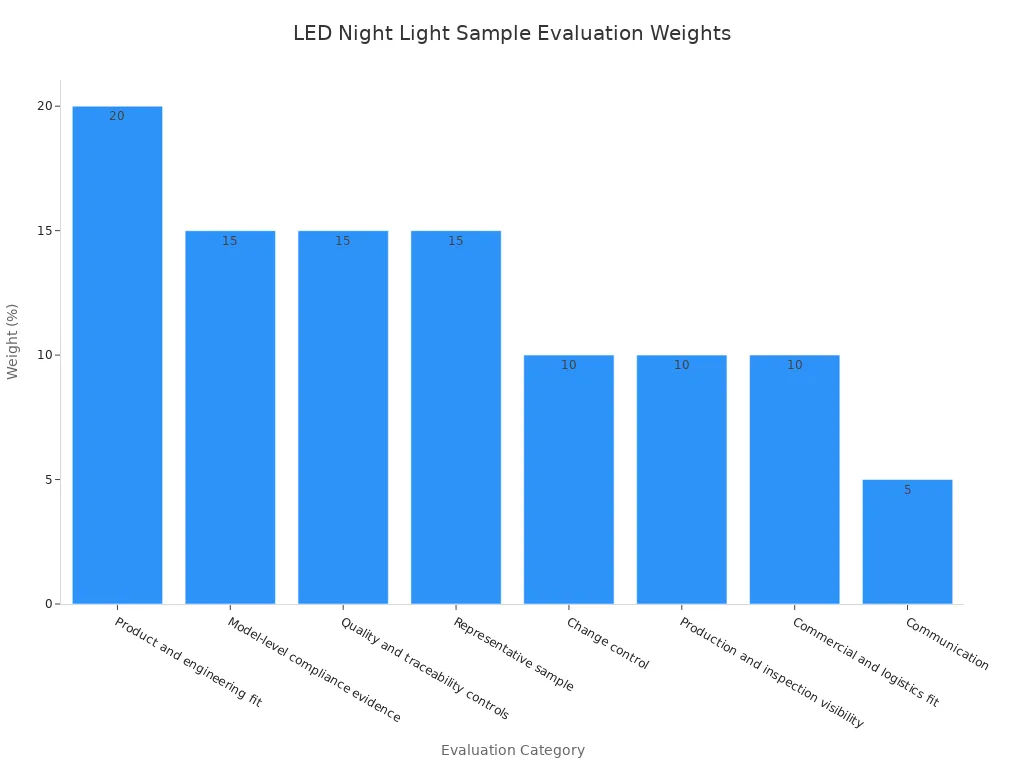
Notice where the weight sits. Product fit and compliance together make up more than a third of the total score. That balance reflects reality. A factory with great prices but poor compliance evidence will cost you far more in the long run.
Evaluate Sample Quality and Consistency
Samples tell you what the factory can actually build. But not all samples are equal. A prototype sample is hand-built with extra care and premium parts. A production sample comes off the real assembly line. You want the second kind. Always request production samples, since they reflect what your bulk order will look like.
Ask the supplier to pull samples from a recent production run. If they refuse or stall, treat that as a warning sign. A factory that stands behind its process will happily send real units. A factory that hides its line quality will not.
Once the samples arrive, test each unit like a customer would. Plug it into a wall outlet. Check the brightness. Watch for flickering or uneven lighting. Feel the housing after a few hours of use. A quality unit stays warm, not hot. Test the dusk-to-dawn sensor by covering it with your hand. Confirm smooth on/off behavior. Try touch dimming if the model has it.
Run a four-hour continuous heat test on every sample. Check the housing and plug for discoloration or warping. A hot-running night light is a fire risk. Inspect connectors and prongs closely. Wiggle them to detect looseness. Loose connections can cause arcing and fires. Confirm the cable size and connector temperature rating match the actual operating temperature.
Order at least three samples from different production batches. This step catches inconsistency. Batch A might be perfect. Batch B might flicker. Batch C might have a crooked housing. One good sample proves nothing about the next thousand units.
Verify certifications along the way. Request actual test reports and declarations of conformity. Check for standards such as IEC 60598-1, UL 2108, or UL 8750. Do not trust a logo on the box alone. Document everything during testing. Take photos of defects. Record batch numbers and receipt dates. This record protects you if bulk production fails to match the sample.
A sample is only useful when its identity and relationship to production are clear. Record the model, revision, components, finish, control configuration, and date. Mark any hand-built or substitute elements that will differ in mass production. Evaluate the sample against a written checklist. Cover dimensions, mounting, connectors, finish, workmanship, switching, dimming, light distribution, labeling, and packaging. Do not rely on general appearance. Follow the applicable plan for technical or compliance testing. After approval, keep a controlled reference or golden sample alongside drawings and an approved specification. Sample success does not prove production consistency. It only proves that one identified sample met the agreed review. You must then verify that the supplier can reproduce it through controlled materials and processes. Define which changes require notification and your approval. These changes include electrical components, LEDs, optics, materials, dimensions, firmware, controls, labels, packaging, and manufacturing location. Record how revisions are tracked and how retesting gets determined.
Quality goes deeper than a single test. Reliability should be assessed by understanding how the product performs over time, not just on day one. Ask how the manufacturer measures degradation. Ask what conditions were used during testing. Ask whether the expected lifespan is grounded in real validation rather than optimistic marketing language.
Thermal management is one of the biggest predictors of long-term LED performance. Excess heat can shorten life, shift color temperature, reduce light output, and increase early failure. Ask how heat is managed. Ask how performance changes at different ambient conditions, especially in enclosed housings or outdoor installations.
Light quality is one of the easiest things to describe poorly and one of the most important to get right. Ask about color rendering, color temperature, consistency, and beam behavior. Check whether the product focuses light in a way that matches your application. A brighter light is not always a better one if beam control, uniformity, or optical balance is wrong.
Review Communication and Lead Times
Communication separates good factories from great ones. You will exchange hundreds of messages over a project. How a factory handles those messages predicts how they handle your order. Pay attention from the first email. Do they answer your questions directly? Do they flag problems before you find them? Do they send updates without you asking?
Test them early. Send a detailed question about a technical spec. See how long they take to reply. Check whether the answer addresses your actual question. A factory that responds in hours with clear answers is worth more than one that responds in days with vague ones. Ask who your main contact will be. Ask who covers for them when they travel or take leave. A single point of contact keeps your project moving.
Lead times deserve careful review. Ask for a realistic timeline, not a best-case one. A good partner builds buffer into the schedule. They know that tooling delays, material shortages, and testing backlogs happen. They plan for them. A factory that promises an impossibly fast turnaround is either inexperienced or dishonest.
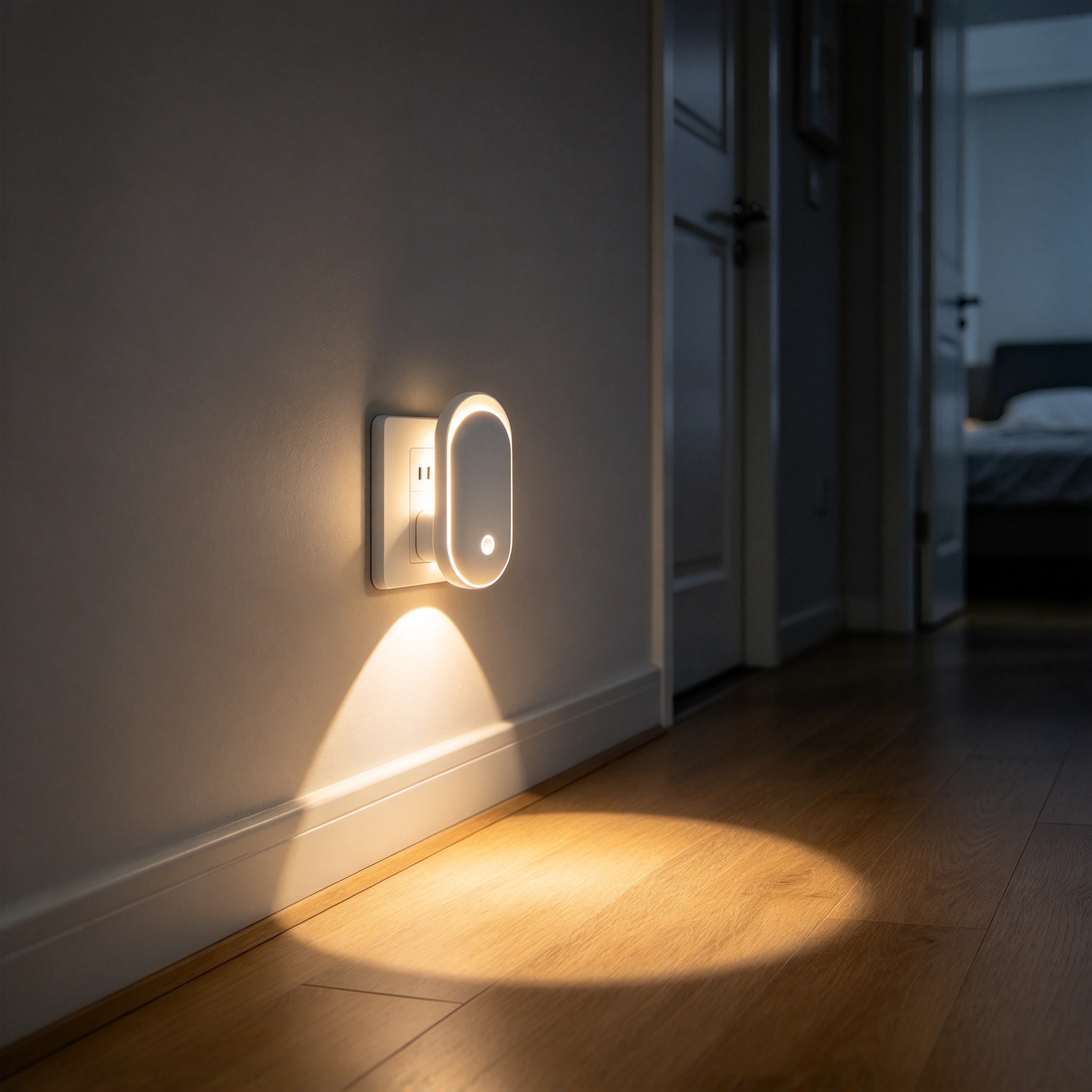
A96HWX Compact Plug-In Night Light
- Compact oval housing with warm LED output
- Plug-in format for hallways and landings
- Downward light throw for floor guidance
- Available for OEM branding and packaging
Get the timeline in writing. Break it into stages. Include design approval, sample rounds, tooling, pilot run, mass production, and shipping. Ask what happens if a stage slips. Ask how they communicate delays. A factory that hides bad news until the last minute will wreck your launch.
Watch for these warning signs during your conversations:
- Slow or vague replies to direct questions
- Reluctance to share test reports or audit documents
- Pressure to skip sample rounds or rush tooling
- No clear contact person or project manager
- Quotes that change without explanation
- Refusal to put specifications or timelines in writing
Any one of these signs might be a misunderstanding. Two or more together should make you look elsewhere. You have plenty of options. Choose a partner who treats your project like their own.
A good oem night light factory will welcome your questions. They will send photos and videos from the line. They will tell you when something needs more time. That transparency builds trust. It also makes your launch smoother. You spend less energy chasing updates and more energy growing your brand.
Compare MOQs, Pricing, and Payment Terms
Minimum order quantities, pricing, and payment terms shape your cash flow and your risk. You need to understand all three before you sign anything. A factory that looks cheap on the surface can drain your budget through hidden costs and rigid terms.
Start with the MOQ. This number tells you the smallest order the factory will accept. MOQs vary widely across the industry. A factory that specializes in small custom runs might ask for 500 units. A large contract manufacturer might demand 5,000 or more. Your MOQ depends on your tooling, your materials, and your production method.
Ask your factory how they calculate the MOQ. Some factories set it by the mold. Each injection cycle produces a fixed number of parts. Running the machine for a small batch wastes time and material. Other factories set the MOQ by their material suppliers. They buy plastic resin and LED components in bulk. A tiny order forces them to buy small quantities at higher prices.
You can often negotiate the MOQ. Here are a few approaches that work:
- Offer to pay a higher unit price for a smaller first order.
- Combine multiple SKUs into one production run to hit the total quantity.
- Ask about stock models or existing tooling that skips setup costs.
- Start with a pilot run and commit to a larger order later.
Pricing works the same way. The unit price drops as your quantity rises. Ask for a price break table. This table shows the cost per unit at different order volumes. A typical table might show prices for 500, 1,000, 3,000, and 5,000 units. You can then calculate your margins at each level and pick the volume that fits your budget.
Watch for costs that sit outside the unit price. Tooling fees, mold maintenance, sample charges, and packaging setup all add to your total. Ask for a full quote that lists every line item. A quote that only shows the unit price hides the real cost. You want to see the tooling cost, the packaging cost, the testing cost, and the shipping cost broken out separately.
Payment terms protect both sides. Most factories ask for a deposit before production starts. A common split is 30% upfront and 70% before shipment. Some factories ask for 50% upfront. Others offer 30% upfront, 40% before shipment, and 30% after you inspect the goods. The terms you get depend on your relationship and your order size.
Here is what to negotiate in your payment terms:
- Keep your deposit as low as possible to protect your cash flow.
- Tie the balance payment to a passed inspection, not just a ship date.
- Ask for a letter of credit if your order is large.
- Confirm the currency and the exchange rate policy.
- Get the payment schedule in writing with specific dates.
A good oem night light factory will work with you on terms. They understand that cash flow matters for a growing brand. They will also be honest about their own constraints. A factory that refuses to budge on a 50% deposit for a first order might not trust new buyers. That caution is reasonable. But a factory that demands full payment upfront with no inspection clause is a risk you should not take.
Red Flags to Avoid
You have done your homework. You checked certifications. You tested samples. You compared quotes. Now you need to watch for the warning signs that separate a reliable partner from a costly mistake. Some red flags are obvious. Others hide behind a polished website and a friendly sales pitch. Learn to spot them early.
Start with the paperwork. Certifications are your first line of defense. A certificate that looks official can still be worthless. Check the issue date. A certificate older than three years may not apply to the current model. Check the model number on the certificate. A mismatch means the certificate covers a different product. Check the testing lab. An unknown lab might issue fake certificates. You can verify lab accreditation at IAF.
The table below shows the most common certificate red flags and how to verify each one.
| Red Flag | What It Means | How to Verify |
|---|---|---|
| Certificate older than 3 years | Outdated and may not apply to the current model | Check the issue date |
| Product model mismatch | Certificate covers a different product | Cross-reference model numbers |
| Testing lab unknown | Possible fake certificate | Verify lab accreditation at IAF |
Samples tell you another story. A factory that sends one perfect sample might be hiding inconsistent production. You need more data. Follow these steps to evaluate any potential supplier:
- Order 3–5 samples.
- Conduct or commission performance testing.
- Evaluate packaging and documentation.
- Test communication and support responsiveness.
That last step matters more than most buyers realize. A factory that answers your sample questions in hours will likely answer your production questions in hours too. A factory that goes silent after the sale will leave you stranded when problems arise.
Some red flags come from the factory's own claims. Be careful when a supplier calls themselves a factory but cannot show you the production floor. Trading companies often pose as manufacturers. They take your order and outsource it to a real factory. You lose control over quality and timelines. You also pay a markup for nothing.
A European wholesaler placed a $200,000 order after seeing impressive factory photos. Upon delivery, products were clearly inconsistent. Investigation revealed the "factory" was actually a trading company using photos from another facility. The actual manufacturer was a small workshop with no testing equipment.
That story is not rare. It happens to buyers who skip the audit step. According to a 2023 survey by the Global Lighting Association, 78% of wholesalers who conducted factory audits avoided problematic suppliers, while 64% who did not conduct audits experienced quality issues. The lesson is clear. A factory tour or a third-party audit protects your investment.
Watch for these additional red flags during your search:
- Quotes that change without explanation or new requirements.
- Pressure to skip sample rounds or rush into tooling.
- No clear project manager or single point of contact.
- Refusal to put specifications, timelines, or payment terms in writing.
- Vague answers about where the product is actually made.
- Unwillingness to share test reports or audit documents.
- Prices that sit far below every other quote you received.
That last point deserves special attention. A price that looks too good usually is. A factory that undercuts everyone else may cut corners on materials, safety testing, or labor. Those shortcuts show up later as returns, recalls, or legal problems. You save a few cents per unit and lose thousands in damage control.
Trust your instincts. If a factory makes you feel rushed, confused, or ignored, walk away. You have options. The right partner will welcome your questions, share their documents, and treat your project with care. That partner is worth the extra time it takes to find them.
For the purchasing conversation around MOQ and pricing, see wholesale night lights: MOQ, pricing and OEM options.
Private Label and Packaging Customization
Your brand lives or dies on the details customers can see and touch. Private label customization turns a generic night light into your product. It also builds trust every time someone opens the box.
Logo Printing and Branding Options
You have several ways to put your mark on the product. You can print your logo on the housing, engrave it on the base, or add a branded silicone ring. You can also customize facial expressions, body proportions, lighting colors, and textures. Seasonal branding works well too. Limited-edition colors for Christmas, Easter, or back-to-school promotions give buyers a reason to come back. Your aesthetic direction matters here. Some brands go minimalist with soft neutral colors. Others choose playful cartoon faces for younger children. Pick a style that matches your audience and stick with it.
Custom Retail Boxes and Inserts
Packaging shapes the first impression. You can choose from several formats:
- Premium rigid gift boxes for high-end positioning
- Eco-friendly paper packaging for sustainability-focused buyers
- Colorful retail display boxes for shelf presence
- Compact e-commerce shipping packaging for online sales
Custom inserts hold the light and accessories in place. They also add a premium feel. A well-designed insert protects the product during shipping and makes unboxing memorable.
User Manuals, Labels, and Barcodes
Your manual is more than instructions. It is a brand touchpoint. Write it in clear language. Include safety warnings, care tips, and warranty details. Add your logo and contact information on every page. Labels must meet each market's rules. Include the model number, voltage, and certification marks. Barcodes need to match your retail channel. Amazon requires an FNSKU. Walmart needs a GS1 UPC. Always approve a printed sample before mass production. A misplaced barcode or missing label can delay your entire shipment.
Eco-Friendly and Premium Packaging Choices
Packaging sends a message before anyone plugs in your night light. You can go green, go upscale, or blend both. Each path attracts a different buyer. Pick the one that matches your brand story.
Eco-friendly packaging wins with parents who care about the planet. You can use recycled cardboard, soy-based inks, and paper inserts instead of plastic trays. FSC-certified paper tells buyers your materials come from responsible forests. Some factories now offer biodegradable bags and compostable wrap. These choices cost a bit more per unit. They also earn you loyalty from eco-conscious shoppers who read every label.
Premium packaging goes the other direction. A rigid gift box with a magnetic closure feels expensive in the hand. Soft-touch lamination, foil stamping, and embossed logos add a luxury feel. Custom foam or molded pulp inserts hold the light snug and safe. This route works well for gift sets, holiday editions, and higher price points. Buyers often keep the box and reuse it. That keeps your brand visible long after the sale.
Here is a quick comparison to help you decide.
| Feature | Eco-Friendly | Premium |
|---|---|---|
| Main material | Recycled paper, FSC board | Rigid board, foil, soft-touch film |
| Cost per unit | Low to medium | Medium to high |
| Best for | Sustainability-focused brands | Gift and luxury buyers |
| Buyer reaction | "This brand cares." | "This feels special." |
You do not have to choose one forever. Many brands run eco packaging as their standard line and premium boxes for limited editions. Ask your factory for samples of both. Hold them, open them, and imagine your customer doing the same. The right box makes your night light feel worth every dollar.
Practical Tips and Case Examples
Start with a Small Test Order
You have a brilliant design and a factory ready to build it. Before you commit to thousands of units, place a small test order first. Order 100 to 300 pieces. Sell them to real customers. Watch what happens. Do people love the brightness? Does the battery last through the night? A small run costs little and teaches you plenty. You catch problems early. You also test your packaging and your shipping process. Once you know your product works, scale up with confidence.
Lock Specifications in Writing
Verbal promises mean nothing when production starts. Write down every detail. Include the LED color temperature, the battery capacity, the material type, and the finish. Add your packaging specs and your label placement. Both you and your factory sign this document. The approved sample becomes your golden reference. Every unit gets compared against it. This step prevents disputes. It also gives you proof if a batch arrives wrong. A written spec sheet protects your brand and your budget.
Plan for Shipping and Retail Compliance
Your product must survive the journey and pass retail rules. Plan for both before your goods leave the factory. Choose your shipping method early. Sea freight saves money but takes weeks. Air freight moves fast but costs more. Book your freight forwarder during peak season. Confirm your labels and barcodes match each retailer's rules. Amazon wants an FNSKU. Walmart needs a GS1 UPC. Test your packaging with a drop test. A crushed box or a missing barcode delays your launch. Plan ahead and your product arrives ready to sell.
Example: Launching a Kids' Night Light Brand
Imagine your brand name on a soft silicone night light that glows warm amber in a toddler's room. An OEM night light factory makes that vision real.
Start with a small batch of 100 lamps. Each one costs around €8, so your total investment lands near $1,000. It's a low-risk test. Sell a few at local markets or on Etsy. If parents love the light, order 500 units. The price drops to about €6 each, and your margin grows. Wholesale prices span a wide range. A simple nightlight might cost $3. A feature-rich themed lamp can reach $63.
The production path looks like this. First, you share your sketches or 3D models. The factory builds a working sample. You check the sizing, the color, and the functionality. Approve the sample, and bulk manufacturing begins. The factory runs quality checks throughout production. Next comes packaging and branding. Add your logo, custom box, and manual. Finally, a pre-shipment inspection confirms everything matches your approved sample.
Lead times shift with customization. Light customization takes 15 to 25 days for samples and 20 to 30 days for bulk. High customization takes 30 to 50 days for samples and 25 to 35 days for bulk. The clock starts after you approve the specs and pay the deposit. MOQs range from 10 to 1,000 pieces. Fully custom designs may add tooling fees for new molds. Some factories credit them later.
Do not skip compliance. Selling in Europe means CE, RoHS, and EN71 certifications. North America requires UL or ETL marks. Ask for current test reports before you commit. A third-party inspection before shipping also lowers your risk.
A branded kids' night light needs a modest budget and a clear plan. Pick the right factory. Lock your specs in writing. Use a golden sample to keep quality consistent. Your brand story begins with that first glowing shelf.
Lock in your manufacturing model, product specs, and compliance needs before you pay for tooling. Pick a factory based on certifications, sample quality, and communication. Price matters, but it should never be your only filter. Treat private label and packaging as core brand assets. They shape how customers see you. Reach out to your oem night light factory early. You will align design, budget, and timeline from day one. That early talk makes your launch smoother and your product stronger.
Ready to Source Quality LED Night Lights?
Contact Guangli today for a free quote and sample!
Get a Quote Request a Sample
Sources and References
- UL Solutions - safety certification and the ETL listing mark ul.com
- Intertek - product testing and certification intertek.com
Updated October 14, 2026
Ready to Source Quality LED Night Lights?
Contact Guangli today for a free quote and sample!
0users like this.