Sourcing Guide
Night Light Export Supplier: Plug Standards, Certifications, Packaging & Shipping Guide
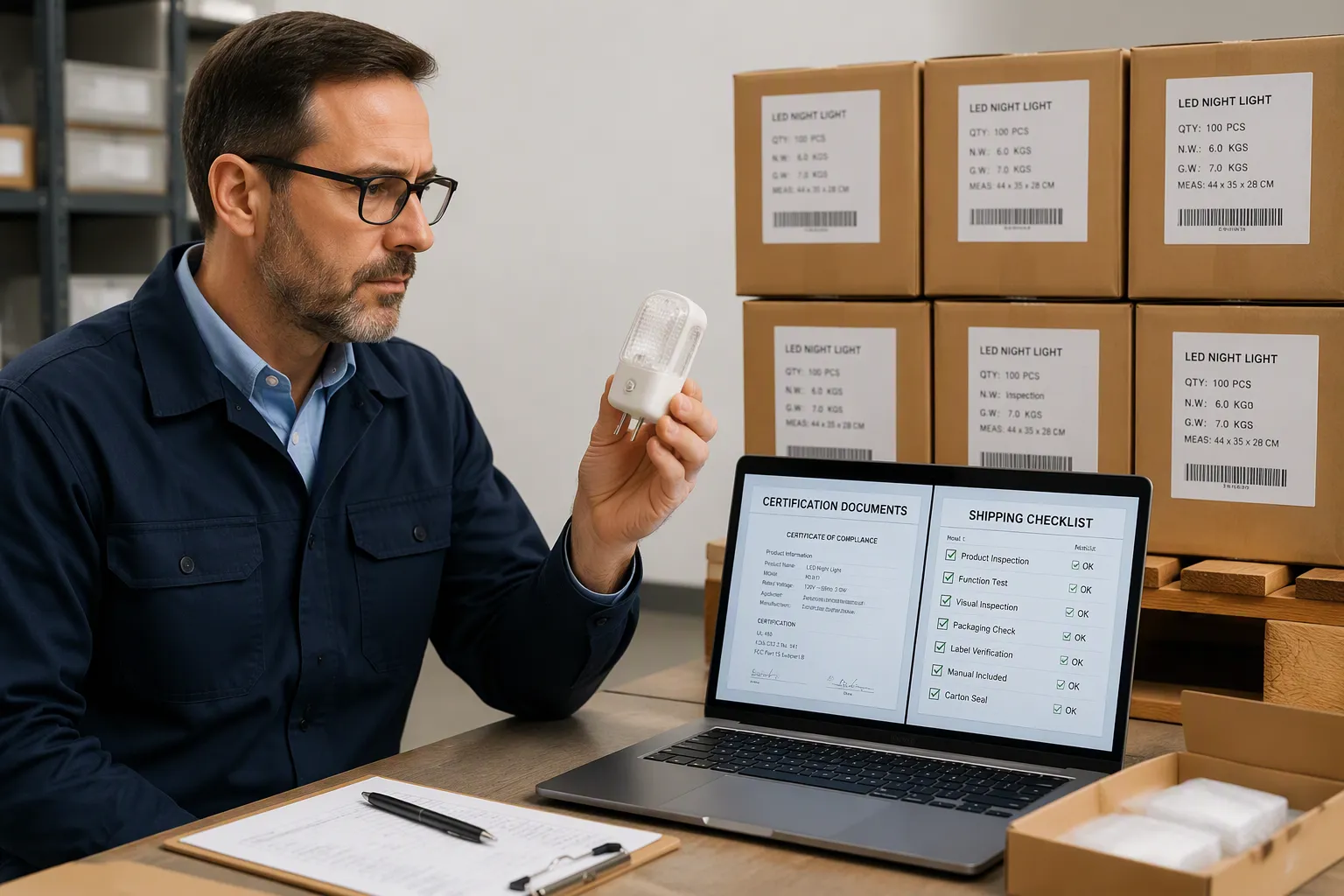
Your night light can work perfectly and still get refused entry or pulled from shelves. The reason is almost never a product defect. Customs detention and marketplace delisting usually come from predictable, preventable compliance gaps: the wrong plug, a missing certificate, or labeling that doesn't match the destination market.
You can't patch these issues after production. Plug standards, certifications, packaging, and shipping documents need to be planned together at the development stage. Choosing a night light export supplier who builds compliance into the process is the single biggest risk-reduction step you can take.
Key Takeaways
- Plan plug standards and voltage for each market before production to avoid customs issues.
- Secure required certifications like UL, CE, or UKCA early to prevent delays and rejections.
- Design packaging with correct labels and warnings to meet retailer and customs rules.
- Prepare complete shipping documents in advance to ensure smooth customs clearance.
- Choose a supplier who builds compliance into every step for a worry-free export process.
Plug Standards by Major Market
A plug is the first physical contact your night light makes with a customer's wall. Get it wrong, and nothing else matters. The unit won't fit the outlet, or it fits but runs on the wrong voltage. Either way, you face returns, refunds, or a customs hold. So let's walk through the plug standards for the markets you're most likely to sell into.
United States and Canada
The US and Canada share one electrical system, which makes life easier for you. Both markets run on 120V at 60Hz. Your night light needs a Type A or Type B plug to work there.
| Country | Voltage | Frequency | Plug Types |
|---|---|---|---|
| United States | 120V | 60Hz | Type A (two flat parallel prongs), Type B (two flat prongs with grounding pin) |
| Canada | 120V | 60Hz | Type A (two flat parallel prongs), Type B (two flat prongs with grounding pin) |
Type A is the familiar two-flat-prong plug with no ground. Type B adds a round grounding pin below the two flat prongs. Most small night lights use Type A because they draw very little power. Check your product's design before you decide. A grounded design needs Type B, and a two-prong design needs Type A. One plug design can serve both countries, so you can build one SKU for the entire North American market.
Watch the voltage rating on the adapter or driver inside the night light. A 120V-only design will fail in Europe. A 100-240V design gives you flexibility across markets. That flexibility costs a little more upfront. It often saves you far more later.
European Union
The EU runs on 230V at 50Hz, with a 220-240V tolerance range. The standard plug is Type C, the two-round-prong plug, or Type F, which adds two grounding clips on the sides. Type F, often called Schuko, is the most common wall outlet in most EU countries. Many night lights ship with a Type C plug because it fits both Type C and Type F sockets.
Voltage is the bigger trap here. A night light built for the US market will not survive a 230V outlet. You need a design rated for 220-240V at 50Hz. If you plan to sell the same product in both regions, specify a wide-range power supply from the start. Retrofitting voltage support after tooling is expensive and slow.
The EU also has one plug standard across all member states, so a single EU-compliant plug design covers the whole bloc. That's a real advantage for your inventory planning. You build one version and ship it to Germany, France, Spain, or anywhere else in the union.
United Kingdom
The UK sits outside the EU plug system, and that catches a lot of buyers off guard. The country uses the Type G plug, which has three rectangular prongs. It looks nothing like the two-round-prong Type C or Type F plugs you see across continental Europe.
| Standard | United Kingdom |
|---|---|
| Voltage | 230V (220-240V range) |
| Frequency | 50Hz |
| Plug Type | Type G (three rectangular prongs) |
The voltage and frequency match the EU, so a 220-240V, 50Hz design works in both places. The plug does not. You cannot ship an EU Type C night light into the UK and expect it to sell. The prongs won't enter a UK socket without an adapter, and a product that needs an adapter looks unfinished to a shopper.
Plan a separate UK SKU with a molded Type G plug. The internal electronics can stay the same as your EU version. Only the plug and the packaging change. That keeps your tooling costs down while giving you a product that fits UK outlets right out of the box.
Devices designed for other voltages, such as 120V, need proper adapters or converters to avoid equipment failure or hazards. Don't rely on a travel adapter as a permanent solution. Build the correct plug and voltage rating into the product itself.
Australia and New Zealand
Australia and New Zealand share a plug standard, and it's one you'll recognize if you've ever sold into China. Both countries use the Type I plug. That plug has two flat blades set in a V shape, plus a grounding pin on grounded versions. The table below lays out the basics.
| Attribute | Standard |
|---|---|
| Plug type | Type I |
| Applicable countries | Australia, New Zealand (also China) |
| Pin configuration | Two or three pins (depending on grounding) |
| Voltage | Typically 220–240V |
The voltage range sits at 220–240V, so a design built for the EU will usually handle the electrical side without changes. The plug is the part that trips people up. A Type C or Type F plug will not fit an Australian socket. You need the V-shaped Type I blades, and you need them molded onto the product.
Here's a detail worth noting. Australia and New Zealand also use the same plug type as China. That gives you a useful production advantage. One Type I plug design can serve three markets, which cuts your tooling and inventory complexity. Just confirm the voltage and certification requirements for each country separately, because the plug is only one piece of the puzzle.
Grounding deserves a quick check. Small night lights often ship with two-pin Type I plugs because they draw little current. Larger or metal-bodied designs may need the three-pin grounded version. Match the pin configuration to your product's electrical design, not to what's cheapest to source.
Australia also has its own regulatory mark for electrical products, and New Zealand recognizes it too. Build that requirement into your certification plan early. A plug that fits but lacks the right mark still won't clear the border.
Japan and Other Key Markets
Japan looks simple at first glance, and then it surprises you. The country uses the Type A plug, the same two-flat-prong design as North America. That's where the similarity ends. Japan runs on 100V, not 120V. The frequency also splits: eastern Japan (Tokyo, Yokohama) runs at 50Hz, and western Japan (Osaka, Nagoya) runs at 60Hz.
A 100V rating covers both halves of the country. A 120V-only design may work in practice, but it sits outside the stated tolerance and creates risk. Specify a 100V-rated design for Japan, and confirm it handles both 50Hz and 60Hz. Most modern drivers do, but you should see it on the datasheet before you commit.
Japan also expects its own certification for many electrical products, and the requirements vary by product category. Check the current rules for night lights before you finalize the design. The plug is easy. The paperwork is where buyers lose time.
China is the next market to plan for. It uses the Type I plug, so your Australia and New Zealand design carries over. The voltage is 220V at 50Hz, which fits the same 220–240V range. China also requires its own certification mark for many products. Treat China as a separate compliance project even though the plug matches.
South Korea uses Type C and Type F plugs, similar to continental Europe. The voltage is 220V at 60Hz. That 60Hz frequency is the detail to watch. A design rated only for 50Hz may not perform correctly. Confirm dual-frequency support before you ship.
India uses Type C, Type D, and Type M plugs, with 230V at 50Hz. The mix of plug types means you should confirm which socket your target retailers expect. Type D is common in older buildings, and Type M appears in some higher-power installations. For a small night light, Type C is usually the safe choice, but verify with your buyer.
Brazil uses Type N plugs, with 127V in some regions and 220V in others. That split voltage is unusual, and it makes Brazil a market where a wide-range design pays off. A 100–240V input handles both regional voltages without a second SKU.
The pattern across all these markets is the same. Plug type, voltage, frequency, and certification move together. You can't solve one without checking the others. Build a simple matrix for every market you plan to enter. List the plug, the voltage, the frequency, and the required mark. Share that matrix with your supplier before tooling begins. It takes an hour to build and saves months of rework.
One more point on multi-market strategy. Wide-range voltage designs cost slightly more per unit. They also let you serve more markets from one production run. For a night light with modest power draw, the cost difference is small. The flexibility is worth far more than the savings from a single-voltage design. Talk to your supplier about which markets you plan to enter over the next two years, not just the next order. That conversation shapes the electronics, the plug tooling, and the packaging all at once.
Certification Requirements for Night Lights
A plug that fits is only half the battle. The other half is proving your night light is safe, and that proof comes in the form of certification marks. Retailers won't stock an uncertified electrical product. Marketplaces will delist it. Customs may hold it. So treat certification as a design input, not a paperwork afterthought.
Here's the good news. The certification landscape for night lights is well mapped. You just need to know which mark each market expects, what testing it involves, and how long it takes. Let's break it down market by market.
North America: UL and ETL Marks
In the US, the safety mark on your night light comes from a Nationally Recognized Testing Laboratory, or NRTL. UL and ETL are the two names you'll see most often. Both carry equal legal weight. Neither one is "better" than the other in the eyes of a US retailer or a customs officer.
UL stands for Underwriters Laboratories. It's the oldest and most recognized mark in North America. ETL comes from Intertek, and it has grown into a full peer of UL over the past two decades. A product bearing either mark meets the same safety standard. The difference is who does the testing and who issues the certificate.
For night lights, the relevant standard is UL 1786, the standard for direct plug-in night lights. This standard covers the product category specifically. It addresses the risks that matter for a small device plugged directly into a wall outlet: overheating, electrical shock, and fire. Your supplier should test to UL 1786, not to a generic lighting standard.
The testing process follows a predictable path. Your supplier submits samples to the lab. The lab runs the safety tests. If the product passes, the lab issues a report and authorizes the mark. Then comes the part many buyers forget: factory follow-up inspections. Both UL and ETL require periodic factory audits to keep the mark valid. Your supplier needs to accept those inspections and maintain the records.
Timelines vary, but plan for four to eight weeks for a new night light design. A product that already holds a UL or ETL report moves faster. Ask your supplier for the existing report before you commit to a new order. A valid report with your product's exact model number on it saves you both time and money.
One trap to watch: a certificate that lists a different model, a different factory, or an expired date. Retailers check these details. So do customs brokers. Match the certificate to the product you're actually shipping, down to the model number and the manufacturing location.
Europe: CE and UKCA
Europe splits into two certification worlds now, and you need to plan for both. The EU uses the CE mark. The UK uses the UKCA mark. They look similar in purpose, and they cover the same product safety goals, but they are separate legal requirements.
The CE mark is the manufacturer's declaration that the product meets all applicable EU directives. For a night light, the relevant ones are usually the Low Voltage Directive, the EMC Directive, and RoHS. The Low Voltage Directive covers electrical safety. EMC covers electromagnetic compatibility, so your night light doesn't interfere with other devices. RoHS restricts hazardous substances in the product.
CE marking is self-declared for most night lights, but self-declaration still requires evidence. You need a technical file that includes test reports, a risk assessment, and a declaration of conformity. Many buyers assume CE means "no testing needed." That's a costly mistake. A technical file without real test data behind it won't survive a market surveillance check.
The UKCA mark works the same way for the UK market. It became the UK's own mark after the country left the EU system. The technical requirements mirror the EU ones closely, and many test reports carry over. The declaration of conformity is separate, though, and it must reference UK legislation. Don't assume a CE certificate automatically covers UKCA. It usually supports it, but you still need the UK-specific paperwork.
Here's a practical tip for your EU and UK launches. Build one technical file that serves both marks. Use the same test lab and the same test reports where the standards align. Then issue two declarations of conformity, one for CE and one for UKCA. This approach keeps your costs down and your documentation consistent.
Pay attention to the responsible person requirement. The EU now requires a named economic operator established in the EU to sit behind the CE mark. The UK has a similar requirement for UKCA. Your supplier may offer this service, or you may need a local partner. Sort this out before your first shipment, not after.
Canada: CSA C22.2 NO.256:14
Canada has its own certification system, and it doesn't simply accept US marks. The country recognizes marks from accredited certification bodies, and CSA Group is the most established of them. The relevant standard for night lights is CSA C22.2 NO.256:14, which covers direct plug-in night lights for Canadian use.
This standard addresses the same safety concerns as UL 1786: shock, fire, and overheating. The two standards are closely aligned, and many test labs can evaluate a product against both in a single testing program. That's a real efficiency gain for you. Ask your supplier whether the night light can be tested to UL 1786 and CSA C22.2 NO.256:14 together. A combined program usually costs less than two separate ones.
Canada also accepts marks from other accredited bodies, including UL and Intertek, as long as the certification covers the Canadian standard. So you have options. The key point is that the certificate must reference the Canadian standard, not just the US one. A UL mark alone, tested only to UL 1786, does not satisfy Canadian requirements.
The cUL mark is what you'll typically see on a product certified for Canada. It often appears alongside the UL mark as a combined "cULus" mark when one certificate covers both countries. That combined mark is the cleanest outcome for a North American launch. One product, one certificate, two markets.
Bilingual labeling is the other Canadian requirement to plan for. Canada requires English and French on retail packaging and warnings. Build that into your artwork from the start. Adding French text after the packaging is printed means a reprint, and a reprint means delay.
Build Compliance Into Development
Step back and look at the pattern across these three markets. Each one has a specific standard, a specific mark, and a specific set of documents. None of them accept a generic "safety certified" claim. The mark has to match the market, and the certificate has to match the product.
That's why certification belongs in the development phase. When you choose the electronics, you choose the standard. When you choose the plug, you choose the market. When you choose the market, you choose the mark. These decisions lock together early. Changing any one of them later forces you to re-test, re-document, and sometimes re-tool.
A smart sequence looks like this. First, confirm your target markets. Second, list the standard and mark for each one. Third, ask your supplier which certificates they already hold and which models those certificates cover. Fourth, budget the time and cost for any new testing. Fifth, build the certificate details into your packaging and your shipping documents.
Do this before you place a production order. A night light that passes every safety test but lacks the right mark is still unsellable in its target market. The testing was never the hard part. The planning is.
Build Compliance Into Development
You've seen the marks each market expects. Now comes the part that decides whether you actually get them on time and on budget. Compliance works best as a design input. Treat it as a checklist you run after production, and you'll pay for it in rework, re-testing, and delayed shipments.
Here's a sequence that keeps certification on track from day one.
- Lock the target market and its certifications first. Before you approve any design, name the destination market. That single decision sets the plug type, the voltage range, the plastic flammability rating, and the testing standard. A plug-in night light typically needs V0 flame-retardant plastic. The standard follows the market: ETL or UL for the US, cUL or cETL for Canada, CE with RoHS and REACH for the EU, UKCA for the UK, and RCM for Australia and New Zealand.
- Design to pass, not to fix later. Build the certification requirements into the product itself. Use thermal design that keeps the LED and driver from overheating at maximum brightness. Specify V0 flame-retardant PC or ABS plastic. Leave enough creepage distance to pass the dielectric test. Choose a switch rated for the product's actual power draw. Each of these choices is cheap at the drawing stage and expensive after tooling.
- Pre-test before you pay for formal certification. Ask the factory to run internal tests first. A four-hour temperature rise test at maximum brightness, a 1200V dielectric withstand test for one minute, and a V0 flame check will catch most problems. Fixing an issue at this stage costs a fraction of a failed lab submission.
- Start formal certification in parallel with mold making. Once the design is final, send pre-production samples to the lab while the molds are still being finished. This overlap can save four to six weeks of lead time. You're not waiting for the mold and the certificate in sequence. You're running both at once.
- Keep the documentation current. Hold the original certificate for every SKU. Make sure each certificate covers the exact model you ship. Renew before expiry, which usually falls in the one-to-two year range. Keep copies ready for customs and retailers, because both will ask.
A few traps catch buyers again and again. Watch for these.
- A factory's ISO 9001 certificate does not certify your product. That's a quality management system, not a product safety mark. Ask for the product-specific ETL or UL report, then verify the report number on the NRTL website.
- Don't self-declare CE for a plug-in electrical product. These products generally need a Notified Body, and EU customs often rejects a self-declared mark.
- Small changes can trigger re-testing. A new housing color, a different switch, or a brighter LED may pull the product away from the tested sample. Keep the shipping version as close to the certified sample as you can.
- Plan California Prop 65 warnings into the packaging artwork from the start. Adding them after printing means a reprint and a delay.
This is where a good night light export supplier earns their keep. A supplier with an existing certified platform, such as a pre-certified E12 or E14 lamp holder with ETL, cUL, and CE already in hand, can cut certification time from about eight weeks down to two. The same partner can run pre-testing, hand over original certificates and test reports, share NRTL verification links, and flag labeling and Prop 65 needs early. That support turns certification from a bottleneck into a routine step.
Packaging Requirements That Prevent Rejection
Packaging is where compliance becomes visible. A retailer scans your barcode, reads your warnings, and inspects your carton before your product ever reaches a shelf. Get these details right, and your shipment moves smoothly. Miss them, and you face rejection at the warehouse door.
Retail Labeling and Warnings
Your retail packaging carries the proof that your night light belongs in the market. Buyers want verifiable marks, not generic claims. A plain "CE" or "FCC" logo printed without a real certificate behind it won't pass inspection.
| Requirement Area | What You Need |
|---|---|
| Checkout scanning | Accurate barcode and labeling so items scan correctly; errors cause warehouse rejection |
| Outer carton | SKU, quantity, country of origin, and shipping marks |
| Retail packaging | Brand artwork, barcodes, and compliance marks in full color |
| Certification marks | Verifiable marks such as ETL/UL (US), cUL (Canada), CE/RoHS/REACH (EU), FCC (electronics) |
| California warning | Prop 65 warning when applicable |
Build a baseline documentation package before you print anything. Include material test reports, a RoHS declaration, a CE Declaration of Conformity with LVD/EMC/RoHS test reports, FCC authorization for the US, and battery safety documents such as UN38.3 if your design uses lithium cells. Then review the packaging and instruction manual for target-market language and safety warnings. Lock the final artwork with an age warning, instruction card, barcode, and FBA label if you sell through Amazon.
California Prop 65
California enforces its own warning rules, and they apply to any product sold into the state. If your night light contains a listed chemical above the safe harbor threshold, you need a clear Prop 65 warning on the package. Plan that warning into your artwork from the first draft. Adding it after printing forces a reprint and delays your launch. Ask your supplier for material declarations early, so you know whether the warning applies before you commit to a print run.
Master Carton and Transit Protection
Your master carton protects the product and satisfies the buyer's inbound rules. A weak carton means damaged units, chargebacks, or a refused delivery. Design the pack-out with these specifications in mind.
| Requirement Area | Specification |
|---|---|
| Internal separation | Acrylic panels and LED bases separated to prevent friction damage |
| Fixed positioning | Products secured so they cannot move inside the box |
| Corner reinforcement | Extra protection on vulnerable corners |
| Layered protection | Surface layer, cushioning layer, internal support, outer carton |
| Pallet shipping | Stretch film and strapping to stop movement in transit |
| Testing | Drop, compression, vibration, and environmental checks |
Confirm quantity, target channel, exact configuration, and approval date before you compare supplier offers. Request a dated sample or proof, measurable checks, and pack-out details. Pause the order if the approved configuration, artwork, or delivery milestone no longer matches your brief. Link your carton evidence to the freight estimate, so packaging and shipping costs stay aligned.
Sustainability and Material Rules
Sustainability rules now shape how you build and pack a night light. Governments worldwide keep rolling out standards for low-energy lighting and recyclable materials. These standards hit product design and manufacturing directly. Plan for them early, and you avoid a late redesign.
Material choices matter first. Manufacturers in the residential night light market increasingly adopt eco-friendly materials and recyclable packaging. This shift aligns with global sustainability goals. It also appeals to environmentally conscious shoppers. Your buyers notice both.
Here are the material and packaging points to lock down:
- Specify recyclable paperboard for retail boxes and master cartons.
- Cut or eliminate plastic blister packs where the channel allows it.
- Ask for material declarations on plastics, coatings, and inks.
- Confirm RoHS and REACH compliance for the EU market.
- Keep packaging volume tight to reduce freight emissions and cost.
Regulation drives much of this. Two forces stand out:
- Regulation shapes LED night light design across electrical safety, electromagnetic compatibility, and energy efficiency labeling. Regional and national standards ensure environmental and consumer protection.
- In Europe, strict energy-efficiency rules and eco-design directives are the main catalysts pushing consumers and institutions toward LED night lights. Government incentives for efficient lighting reinforce this shift.
Safety, energy efficiency, and environmental rules vary by region. That variation complicates compliance. It also demands real investment in testing, certification, and product adaptation. Build these costs into your quote, not your contingency budget.
One practical move pays off here. Ask your supplier which eco-friendly materials and recyclable packaging options they already stock. A supplier with these options ready can meet sustainability goals without a custom tooling bill. You get a greener product and a cleaner compliance story for your retail buyers.
Shipping Documentation and Customs Clearance
You've built a compliant product. Now you need paperwork that proves it. One missing document can stall your shipment at the port for weeks. Let's look at what you need and how to get it right.
Core Export Documents
Your document set splits into three groups. Each one serves a different purpose at the border.
| Document Category | Required Documents |
|---|---|
| Essential Shipping Documents | Commercial Invoice (product description, HS code, quantity, unit price, total value); Packing List (weight, dimensions, carton/pallet count); Bill of Lading (ocean carrier document); Certificate of Origin (proof of manufacture in China) |
| Compliance Documents (critical for electrical products) | ETL or UL Certificate (with verifiable number); Test Report (NRTL, matching exact product model); FCC Certification (if applicable); Prop 65 Compliance (if shipping to California); Material Safety Data Sheet (MSDS) for certain materials |
| EU Market Additional Documents | CE Declaration of Conformity; RoHS Test Report; REACH Compliance Documentation; WEEE Registration Number; PPWR Packaging Compliance |
Gather every document before the goods leave the factory. Customs wants the file in advance, not on arrival day.
HS Codes and Duty Classification
The HS code decides your duty rate. A night light usually falls under a lighting heading, but the exact subheading depends on its design and function. Ask your supplier which code they use. Then confirm it with your customs broker. A wrong code means wrong duties, and wrong duties mean delays or penalties. State the country of origin accurately too. Goods bought in one country may be manufactured in another, and customs checks this closely.
Working With Freight Partners
A good freight partner does more than move boxes. They keep your paperwork clean and your shipment visible. Here's what they help you verify:
- Accurate item description, preferably in English, to prevent customs misunderstandings
- Correct HS code assignment, since it governs classification and tax
- Accurate country of origin and declared value
- Clear sale currency and full importer and supplier details, including tax IDs
- A complete document set: customs bond, commercial invoice, packing list, and import/export declaration, plus certificates where applicable
Freight partners specializing in air freight simplify international shipping through accurate paperwork and compliance support. Their logistics specialists guide you through each step, help you avoid delays, and coordinate documentation from pickup through delivery. Lean on that support. It turns a stressful border process into a routine one.
Common Pitfalls and How to Avoid Them
Most rejections follow a few predictable patterns. Learn them now, and you can sidestep the expensive surprises later.
Plug and Voltage Mismatches
This is the classic mistake, and it shows up at the port more than anywhere else. A night light built for one market simply won't work in another. Here are the mismatches that cause the most trouble:
- A European product shipped to the US with a Europlug, or a unit that lacks the proper NEMA configuration
- A 120V design sent to a 230V market, where it fails or creates a hazard
- A 50Hz-only design headed to a 60Hz country like South Korea or Japan
You can avoid all three with one habit. Build a market matrix before tooling starts. List the plug, voltage, and frequency for every destination. Then confirm your supplier builds to that list, not to a generic "export" spec.
Missing or Invalid Certificates
A certificate that doesn't match your product is almost as bad as no certificate at all. Watch for reports that list a different model, a different factory, or an expired date. Retailers and customs brokers check these details closely. Ask for the original report, verify the number on the NRTL website, and confirm the model matches what you ship. Renew before expiry, and keep copies ready for every shipment.
Labeling and Prop 65 Gaps
Labeling gaps sneak up on buyers because they look minor until a warehouse inspection. A missing country of origin, an absent certification mark, or a barcode that won't scan can stop your delivery at the door. California Prop 65 adds another layer. If your night light contains a listed chemical above the threshold, you need a clear warning on the package. Ask for material declarations early, so you know whether the warning applies before you commit to a print run. Adding it after printing means a reprint and a delayed launch.
Documentation Errors That Trigger Detention
Paperwork mistakes cost you time and money at the border. Customs officers don't care that your night light works perfectly. They care that your file matches your shipment. Here are the errors that stop goods most often.
- Missing safety certification documents. US CBP requires NRTL certification for electrical products. That means ETL, UL, or cUL. No original certificate or matching test report can lead to immediate detention. This ranks as the top reason for electrical product holds.
- Commercial invoice errors. Your product description must match the actual goods. Listing an electrical night light as a "plastic toy" invites trouble. So does a wrong HS code, a missing country-of-origin mark, or a suspiciously low invoice value. Any of these can trigger anti-dumping or valuation reviews.
- Missing FCC documentation. Night lights with electronic components may need FCC certification. Even a simple LED driver counts. Customs can request the FCC ID and paperwork during inspection.
- Missing California Prop 65 warnings. Shipments to California may need Prop 65 warnings on the product or packaging. Skip them, and you risk fines and detention.
- Missing packaging compliance documents. For the EU, the PPWR regulation requires documentation on packaging materials and recyclability. Leave these out, and EU customs may hold your shipment.
You can dodge every one of these problems with a simple habit. Build a document checklist for each destination market. Check every item before the goods leave the factory. Then send the full file to your broker in advance. A clean file moves fast. A thin file sits in a warehouse while you scramble.
Choosing the Right Night Light Export Supplier
You've seen the full compliance picture. Now you need a partner who can actually deliver it. The right night light export supplier turns everything above into a routine process. The wrong one leaves you chasing certificates at the port.
Questions to Ask Before Ordering
Start with a short conversation. Ask the supplier to state the country of origin of the night light. Ask which factory produced the electronics and the plug. Then ask what export classifications apply in their country and whether any permits are required.
Dig into their compliance procedures next. Ask how they handle import and export documentation, and request manufacturer traceability for every SKU. Confirm how they guarantee warranty and after-sales support. Ask whether any end-user limitations apply to your purchase.
Watch for warning signs too. Be cautious if the seller cannot explain the product's origin. Be cautious if no export or import documentation exists. Be cautious if the supplier dismisses compliance concerns or refuses to discuss the paperwork. A good night light export supplier answers these questions without hesitation.
Compliance Support After Delivery
Compliance doesn't end when the container ships. Certificates expire, and retailers ask for updated files months later. Ask your supplier how they handle renewals and document requests after delivery. Confirm they will resend original test reports and verification links when you need them.
A strong partner also flags regulation changes in your target markets. That ongoing support protects your listings long after the first order lands.
You now have a clear four-step path. Lock the plug standard for each target market. Secure the right certifications before mass production. Finalize compliant packaging and labeling. Then prepare complete shipping documentation. Compliance costs the least when you design it in at the start. It costs the most when you discover a gap at the border. So before your next order, request a compliance consultation with your night light export supplier. Map the plug, certification, packaging, and shipping needs for your specific markets. That one conversation protects your launch.
Ready to Source Quality LED Night Lights?
Contact Guangli today for a free quote and sample!
0users like this.