Sourcing Guide
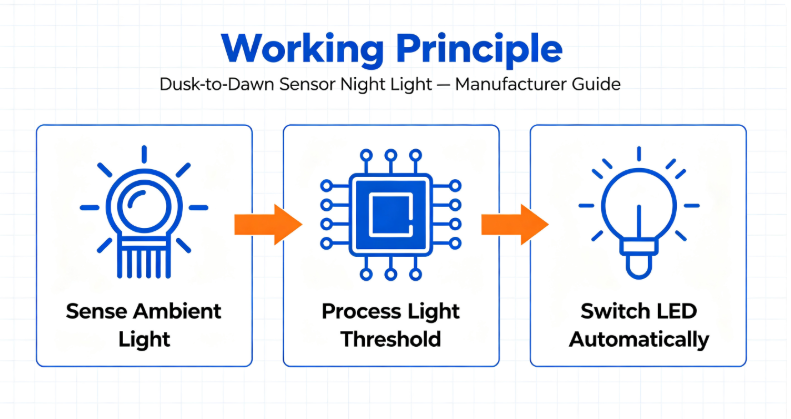
How Dusk-to-Dawn Sensor Night Lights Work: A Manufacturer's Guide
Dusk-to-dawn sensor night lights have become one of the most popular categories in the global lighting market. Unlike manual switch models, these lights automatically turn on when ambient light drops and turn off when daylight returns, providing hands-free convenience for homes, hotels, offices, and public spaces. As a dedicated dusk-to-dawn sensor night light manufacturer with over a decade of production experience, Guangli Electrical Factory has helped hundreds of importers, wholesalers, and private-label brands build successful product lines in this category. This guide explains how the technology works, what to look for when sourcing, and why choosing the right manufacturer matters.
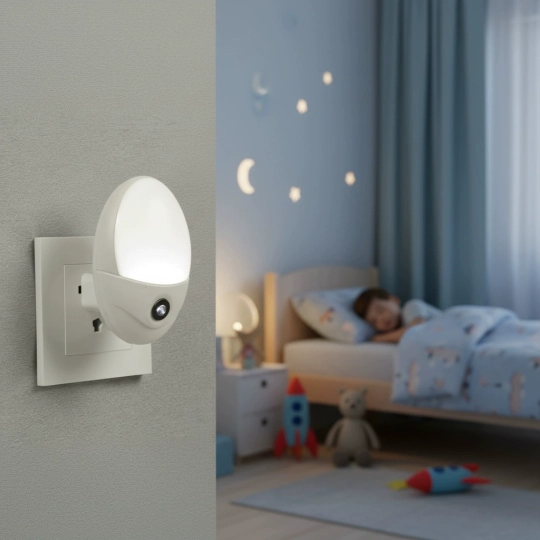
Quick Answer: A dusk-to-dawn sensor night light switches on when a photocell detects that ambient light has fallen below a set threshold, usually around 10 to 20 lux, and switches off again when daylight returns. There is no timer and no motion detection involved. The two values that vary between suppliers are the threshold and the hysteresis, which is how much the light level must change before the sensor changes state again. A poorly set hysteresis makes the lamp flicker at dawn and dusk. The sections below explain the mechanism and what to check on a specification sheet.
Key Takeaways
- A photocell switches the lamp by ambient light level, not by a timer.
- The threshold is usually 10-20 lux; ask for the exact value.
- Hysteresis prevents flicker at dawn and dusk, so ask for it too.
- No motion detection is involved in a dusk-to-dawn unit.
- Verify sensor specs against a sample, not a datasheet alone.
In This Guide
- What a dusk-to-dawn sensor actually detects
- The photocell threshold, in plain terms
- Hysteresis and why flicker happens
- What to specify when sourcing
- How to judge a supplier claim
What Is a Dusk-to-Dawn Sensor?
Photocell Threshold and Hysteresis
A dusk-to-dawn sensor, also known as a photocell or light-dependent resistor (LDR), is an electronic component that detects changes in ambient light levels. When the surrounding environment becomes dark enough - typically below 10 to 20 lux - the sensor triggers the LED to turn on. When natural or room light rises above the threshold, the sensor automatically switches the light off. This cycle repeats every day without any manual operation, making it ideal for spaces where constant low-level illumination is needed only at night.
The sensor works by measuring the resistance of a semiconductor material. In bright light, the resistance drops, allowing current to flow and keeping the LED off. In darkness, the resistance rises, activating the circuit and powering the LED. High-quality dusk-to-dawn sensor night lights use calibrated components to ensure consistent activation thresholds, preventing the light from flickering or turning on prematurely under partial shading.
Why Choose a Dusk-to-Dawn Sensor Night Light?
Where the Sensor Saves Energy
The main advantage of a dusk-to-dawn sensor night light is complete automation. Users never need to remember to turn the light on at night or off in the morning. This is especially valuable for hallways, staircases, bathrooms, and elderly care facilities where forgetting to turn on a light could lead to falls or accidents. The sensor also ensures the light only operates when needed, minimizing energy consumption and extending the LED lifespan.
For B2B buyers, dusk-to-dawn models consistently outperform manual-switch varieties in retail sell-through rates. Consumers are willing to pay a modest premium for the convenience factor, and the low failure rate of modern photocell sensors means fewer returns and warranty claims. As a dusk-to-dawn sensor night light manufacturer, Guangli has observed that sensor-equipped SKUs typically generate 30-40% higher reorder rates compared to basic on/off models among our wholesale clients.
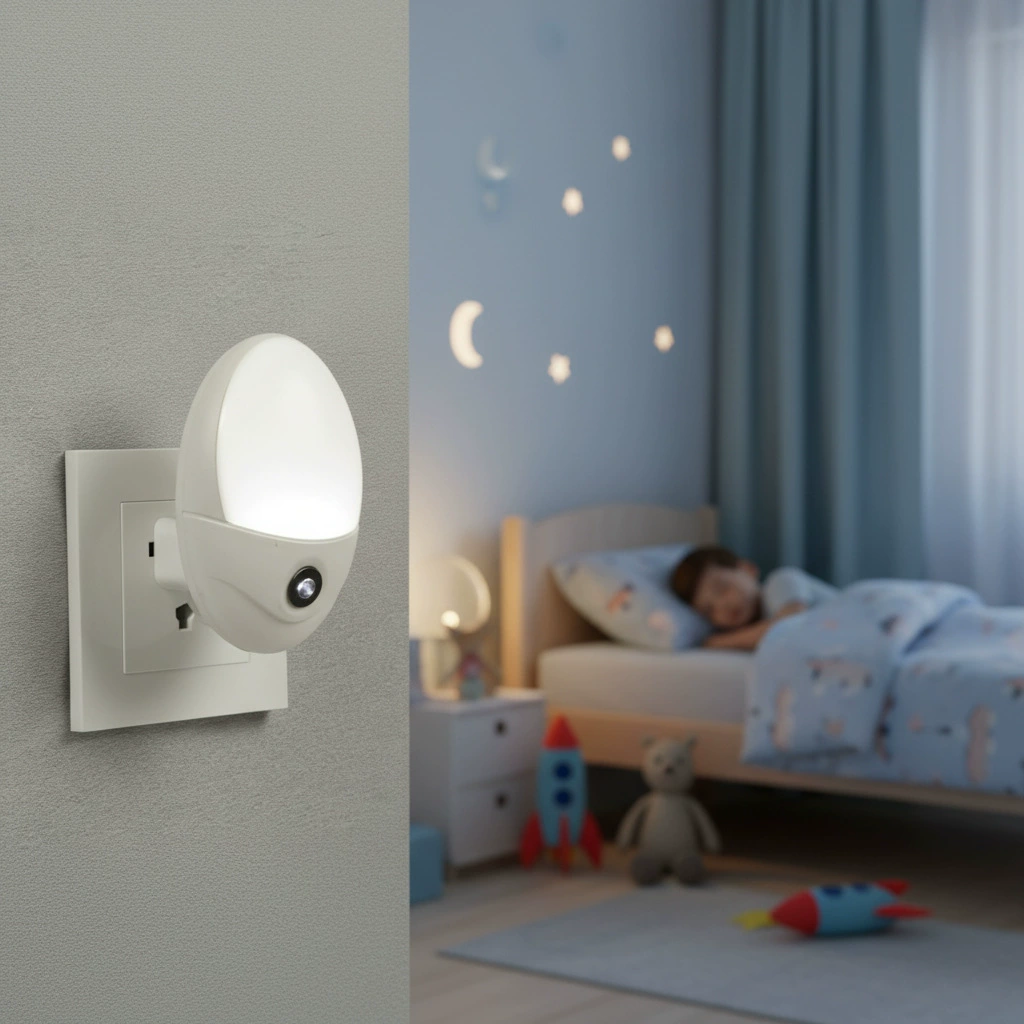
A58 Dusk to Dawn Sensor Plug-in LED Night Light
- Light sensor switches the lamp on at dusk and off at dawn
- AC 110-240V input with a 4 LED design
- Warm white and cool white versions available
- Suited to bedrooms, hallways, and stairwells
View A58 Details
Guangli's A58 Dusk-to-Dawn Sensor Night Light
The A58 is Guangli's flagship dusk-to-dawn sensor plug-in LED night light. Designed for the North American market with a US plug and ETL certification, the A58 features a high-sensitivity photocell sensor that reliably detects ambient light changes. The warm white LED (2700K-3000K) produces a soft, glare-free glow of approximately 5-10 lumens, ideal for bedrooms, hallways, and bathrooms without disturbing sleep.
Key specifications of the A58 include:
• Power supply: Plug-in AC 110-120V, 50/60Hz
• Wattage: 0.5W ultra-low energy consumption
• LED color: Warm white 2700K-3000K
• Sensor: Dusk-to-dawn photocell, automatic on/off
• Plug type: US 2-pin flat plug
• Certifications: ETL, FCC, RoHS
• Material: Flame-retardant ABS housing
• Dimensions: Compact design that does not block the second wall outlet
For OEM and private-label clients, the A58 platform supports logo printing (silk-screen or laser), custom housing colors, modified packaging (blister card, color box, or gift box), and adjustable sensor sensitivity thresholds for regional light conditions. The standard MOQ for customized A58 orders is 5,000 pieces, with a production lead time of 15-25 days.
Related: the A38 UK plug sensor night light.
Where to Use Dusk-to-Dawn Night Lights
Dusk-to-dawn sensor night lights are versatile enough for nearly any indoor space that requires nighttime illumination. Common applications include:
• Hallways and staircases: Prevents trips and falls during nighttime trips to the bathroom or kitchen
• Bathrooms: Provides soft light for midnight visits without the harsh glare of overhead fixtures
• Bedrooms and nurseries: Creates a calming ambient glow that helps children and adults fall asleep
• Kitchens and pantries: Offers enough light for late-night snacks without waking household members
• Hotels and hospitality: Reduces energy costs while improving guest safety and satisfaction
• Elderly care facilities and hospitals: Ensures continuous low-level illumination for patient mobility and staff rounds
• Offices and workplaces: Provides security lighting during off-hours without requiring manual operation
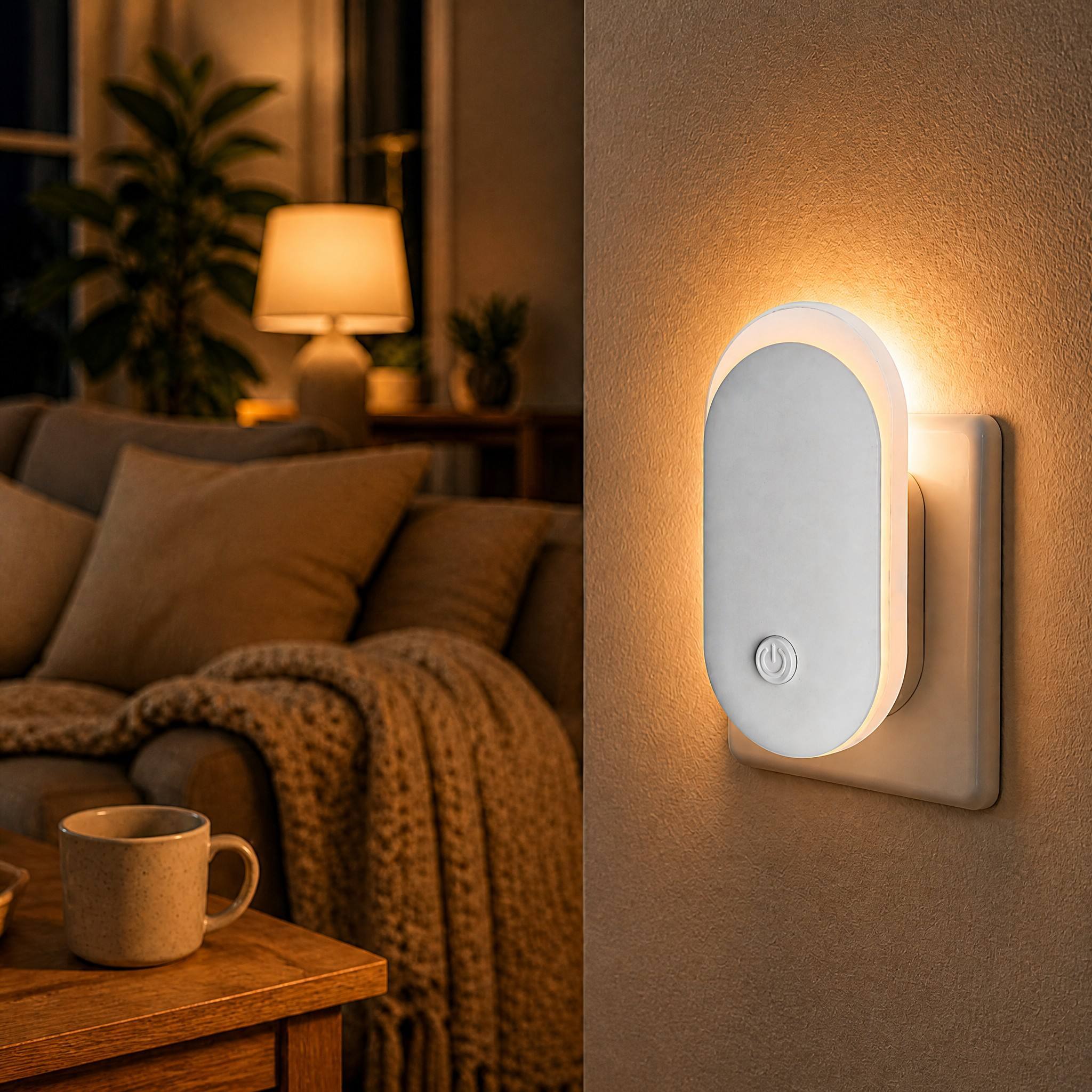
A96TB Dusk to Dawn Sensor Night Light (USB-A + Type-C)
- Dusk-to-dawn light sensor with 3 color temperatures: 3000K / 4000K / 6000K
- USB-A and Type-C charging ports, 5V 2A output
- 1W LED plug-in design for bedrooms and hallways
- CE and RoHS listed; OEM and ODM customization available
Related: the A78 dual-control night light.
What to Look for When Sourcing Dusk-to-Dawn Sensor Night Lights
Related: how to verify ETL and FCC claims.
Specification Checklist
Selecting the right dusk-to-dawn sensor night light manufacturer is critical for product quality, compliance, and long-term profitability. Here are the key factors to evaluate:
1. Sensor Quality and Calibration
Not all photocell sensors are equal. Low-quality sensors may have inconsistent activation thresholds, causing the light to turn on too early, too late, or flicker under changing light conditions. A reputable manufacturer will calibrate each sensor during production and conduct aging tests to ensure stable performance over thousands of on/off cycles. Ask for the sensor's lux activation range and whether it has been tested for at least 500 hours of continuous operation.
2. Safety Certifications
Because dusk-to-dawn night lights are mains-powered plug-in devices, they must meet the electrical safety standards of your target market. For the United States and Canada, look for ETL or UL listing. For Europe, CE and RoHS compliance are required. For the UK, UKCA certification is necessary. For Australia, SAA approval is needed. Always request the actual certificate file and test report for the specific model you intend to buy - not a generic company-level certificate.
3. LED Quality and Color Temperature
The LED is the heart of the night light. High-quality LEDs from reputable brands (such as San'an or Epistar) offer consistent color temperature, long lifespan (typically 30,000+ hours), and low heat generation. For residential night lights, warm white (2700K-3000K) is the most popular choice because it is easy on the eyes and does not suppress melatonin production. Avoid suppliers that cannot specify the LED brand or color temperature tolerance.
4. Housing Material and Fire Safety
The housing should be made from flame-retardant ABS or PC plastic that meets UL94 V-0 or V-2 standards. This is especially important for plug-in devices that remain energized 24 hours a day. Low-quality housings made from recycled or non-flame-retardant plastic can pose a fire risk if an electrical fault occurs. Ask for the material specification and flame-retardant rating before placing an order.
5. Plug Configuration and Compact Design
A good dusk-to-dawn night light should have a compact body that does not block the second outlet on a standard wall duplex receptacle. This is a common complaint among consumers and can lead to negative reviews and returns. Also, confirm that the plug configuration matches your target market - US flat 2-pin, EU round 2-pin, UK BS 1363 fused plug, or Australian SAA plug. Some manufacturers offer interchangeable plug designs, but fixed plugs are generally more reliable and cost-effective.
6. MOQ, Lead Time, and Customization Options
For private-label brands, the ability to customize the product is essential. Look for a manufacturer that offers logo printing, custom colors, modified packaging, and adjustable technical parameters. Confirm the MOQ for each customization level - standard products may have lower MOQs, while fully custom tooling typically requires 10,000+ pieces. Also, verify the production lead time (usually 15-30 days for standard orders) and whether the manufacturer can handle rush orders for peak seasons.
About Guangli Night Light Factory
Chaozhou Guangli Electrical Appliance Factory is a specialized dusk-to-dawn sensor night light manufacturer based in Chaozhou, Guangdong, China. With over 13 years of experience in LED night light and lamp holder production, the factory operates a 3,000+ square meter facility with 5 standardized production lines and a professional R&D team. Our product range includes plug-in sensor night lights, motion-sensor models, touch-dimmable lights, USB charging night lights, decorative designs, and a full line of E12/E14/E26/E27/B22 lamp holders.
We strictly implement the ISO9001 Quality Management System (Certification No.: ISC-Q-2025-7396-R) and maintain a defective rate below 0.2% through three-stage factory inspections, aging tests, and voltage-withstanding tests. Our products hold ETL, cETL, CE, RoHS, UKCA, SAA, FCC, and PSE certifications, enabling smooth access to North American, European, British, Australian, and Japanese markets. We have supplied major retail chains including Walmart, RT-Mart, and The Home Depot, and we offer comprehensive OEM, ODM, and OBM customization services for brands, wholesalers, and cross-border e-commerce sellers worldwide.
Official websites: www.nightlight-factory.com | www.ea-gl.com
Frequently Asked Questions (FAQ)
Q: How does a dusk-to-dawn sensor know when to turn on and off?
A: A dusk-to-dawn sensor uses a photocell (light-dependent resistor) that measures ambient light levels. When the light drops below a preset threshold (typically 10-20 lux), the sensor activates the LED. When ambient light rises above the threshold, it automatically turns the LED off. This cycle repeats every day without any manual intervention.
Q: Can I adjust the sensitivity of the dusk-to-dawn sensor?
A: For standard retail models, the sensor sensitivity is factory-calibrated and not user-adjustable. However, for OEM and private-label orders, Guangli can adjust the activation threshold to suit regional light conditions or specific customer requirements. Simply specify your desired lux range when placing a custom order.
Q: Are dusk-to-dawn sensor night lights safe to leave plugged in all the time?
A: Yes, high-quality dusk-to-dawn night lights are designed for 24/7 continuous operation. Guangli's A58 model uses a flame-retardant ABS housing, ETL-certified electrical components, and an ultra-low 0.5W LED that generates minimal heat. We conduct 500-hour continuous aging tests on every production batch to ensure safety and reliability. Always purchase from a certified manufacturer and avoid unbranded products with no safety certifications.
Q: What is the lifespan of a dusk-to-dawn sensor night light?
A: The LED itself typically lasts 30,000+ hours, which translates to approximately 10+ years of normal nighttime use (about 8 hours per night). The photocell sensor is rated for tens of thousands of on/off cycles. Guangli offers a 1-year warranty against manufacturing defects, and our field data shows an average service life of 5-8 years for most installations.
Q: What is the MOQ and lead time for custom dusk-to-dawn sensor night lights?
A: For standard A58 models with custom logo printing, the MOQ is 1,000 pieces with a lead time of 15-20 days. For fully customized designs (new housing, custom colors, modified packaging), the MOQ is typically 5,000-10,000 pieces with a lead time of 25-35 days, including tooling and prototype approval. Sample orders are available for quality evaluation, with a sample lead time of 3-5 business days.
https://www.nightlight-factory.com/a58-dusk-to-dawn-sensor-plug-in-led-night-light-p7048954.html
Related Guides
- How to choose the right night light for different spaces
- What makes a night light supplier truly reliable
Ready to Source Quality LED Night Lights?
Contact Guangli today for a free quote and sample!
Get a Quote Request a Sample
Ready to Source Quality LED Night Lights?
Contact Guangli today for a free quote and sample!
Get a Quote Request a Sample
Sources and References
- UL Solutions - safety certification and the ETL listing mark: ul.com
- U.S. Federal Communications Commission - equipment authorization and Part 15 rules: fcc.gov
Updated September 29, 2026
Ready to Source Quality LED Night Lights?
Contact Guangli today for a free quote and sample!
0users like this.